

blog
Interior Mouldings for Modern Homes That Work
Oct
A modern room can feel unfinished even when every surface is freshly decorated. The usual cause is not a lack of furniture or colour, but a lack of definition where walls, ceilings, floors and openings meet. Interior mouldings for modern homes solve that problem with controlled architectural detail: enough to give a room presence, without making it feel overly traditional.
For UK renovations, new builds and commercial fit-outs, the most successful schemes use mouldings with purpose. Coving can soften a hard ceiling line, skirting can make flooring feel properly framed, and wall panels can create a focal point without relying on busy wallpaper. The key is choosing the right profile, scale and material for the room rather than adding decoration for its own sake.
What modern mouldings should achieve
Modern interiors are often built around clean lines, calm colour palettes and open space. That does not mean every transition must be sharp or bare. Mouldings give those transitions a deliberate finish, conceal small imperfections and introduce shadow lines that change with the light throughout the day.
The best approach is restrained. A simple stepped cornice may suit a contemporary kitchen-diner better than an ornate profile, while a slim skirting board can complement flush doors and large-format flooring. In a period property being updated, mouldings can also bridge old and new elements, retaining a sense of character while simplifying the overall look.
There is a practical benefit too. Walls and ceilings are rarely perfectly straight, particularly in renovated homes. Coving, flexible mouldings and carefully selected skirting can help disguise minor junction gaps and uneven lines that would otherwise stand out after painting.
Choosing interior mouldings for modern homes
Start with the room, not the product. Ceiling height, natural light, existing joinery and the intended finish all influence what will look right. A profile that works beautifully in a tall Victorian hallway may feel too prominent in a compact new-build bedroom.
Use coving to control the ceiling line
For contemporary spaces, look for coving and cornice profiles with crisp geometry, shallow curves or a minimal stepped shape. These designs provide a clear visual break between wall and ceiling without introducing heavy ornament.
Scale matters more than many homeowners expect. A narrow coving profile is usually appropriate for lower ceilings and smaller rooms. In rooms with generous ceiling height, a taller profile prevents the moulding from looking insubstantial. It is also worth considering the viewing distance: an open-plan room may need a bolder profile than a small sitting room because it is seen from further away.
If you are painting walls and ceilings in the same colour, coving still has a role. The shadow it casts creates quiet depth while keeping the room cohesive. Painting it to match the ceiling gives a lighter, more traditional lift; painting it with the walls can make the ceiling line appear more architectural and contemporary.
Make LED lighting part of the architecture
LED coving and indirect-lighting profiles are particularly effective in modern homes because they combine decoration with a useful lighting layer. Rather than fitting a visible strip light, the LED channel is concealed within the moulding and washes light across the ceiling or wall.
This is a good option for cinema rooms, bedrooms, hallways and living spaces where soft ambient light is more useful than a single central fitting. It also works well around dropped ceilings and media walls. Plan the electrical work early, however. The profile, LED tape, driver position and access for maintenance should be agreed before fitting begins.
A high-output LED can create a striking effect, but more light is not always better. Warm white lighting is generally more comfortable in residential rooms, while a diffused strip helps avoid visible spotting on the wall or ceiling.
Use wall mouldings to create order, not clutter
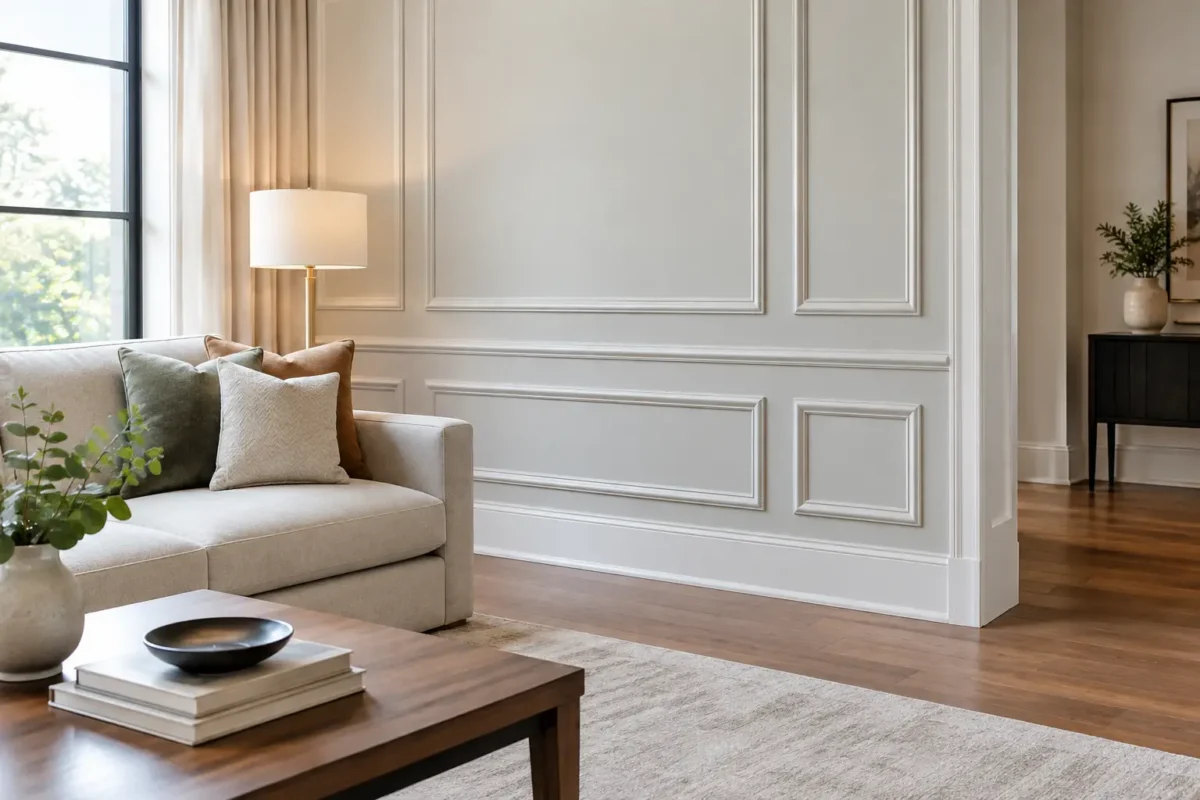
Wall panelling has moved well beyond the traditional dining room. Simple picture-frame mouldings, linear battens and recessed panel effects can make a plain wall feel considered, especially behind a bed, sofa, dining table or reception desk.
For a modern finish, keep the layout disciplined. Align panels with door heads, window reveals, sockets or key furniture where possible. Repeated panel widths create a calmer result than a grid made to fit every last inch of wall. On a feature wall, a small number of larger panels often looks more confident than numerous narrow ones.
Colour has a major influence. Painting the panelling and wall in one shade highlights the relief through shadow rather than contrast. A deeper tone can make a large room feel more intimate, while an off-white finish adds definition without dominating the space. If the wall is likely to receive knocks, such as in a hallway or stairwell, choose a durable paint finish and a moulding material suited to everyday use.
Do not overlook skirting and door surrounds
Skirting boards are one of the clearest signals that a room has been finished properly. They protect the lower wall from scuffs, cover the expansion gap around many floor finishes and establish a consistent line throughout the property.
In modern schemes, square-edged, chamfered and modestly stepped profiles tend to work well. The right height depends on the room and the rest of the joinery. Very low skirting can look sharp in a minimal renovation, but it may not hide old wall damage or previous flooring lines. Taller skirting adds presence and is often useful in older homes, provided the profile remains simple.
Door surrounds deserve the same consideration. A plain architrave can make standard doors feel more substantial, particularly when paired with matching skirting. Where space is limited, select a narrower profile rather than omitting the surround altogether. The goal is a coherent perimeter detail, not a decorative statement at every opening.
Why lightweight polyurethane is suited to renovation work
Traditional plaster mouldings offer authenticity, but they are heavy, fragile and can demand specialist handling. For many refurbishment projects, high-density polyurethane mouldings provide a more practical route to a premium result. They are lightweight, durable, moisture-resistant and supplied ready for painting.
This makes them especially useful when working above head height, fitting long lengths of coving, or upgrading occupied homes where disruption needs to be kept to a minimum. They can be cut accurately with appropriate tools and fixed using the correct adhesive, reducing the mess associated with wet plaster work.
Material choice still depends on the application. Flexible mouldings are valuable for curved bays, arches and rounded walls. Hardwearing skirting profiles are useful in busy circulation areas. For wet rooms, select products and installation materials appropriate for humid conditions, then follow the manufacturer guidance on surface preparation and paint systems.
Orac Decor profiles are designed for this balance of decorative quality and practical installation, making them a strong choice for homeowners and trade professionals who want consistent, paintable finishes without the weight of plaster.
Installation details that make the difference
Even the best profile will disappoint if it is fitted onto loose paint, dusty plaster or an unprepared wall. Surfaces should be sound, clean, dry and reasonably level. Remove unstable material, fill significant voids and mark reference lines before applying adhesive.
Measure each wall individually rather than assuming opposite walls are identical. Check internal and external corners carefully, and dry-fit complicated sections before committing to adhesive. In older properties, it is often better to scribe or make a controlled adjustment than force a perfectly square mitre against an uneven corner.
Use the adhesive specified for the moulding and application. A high-quality joint adhesive is as important as the wall adhesive because it helps create neat, stable joins. Wipe away excess promptly, fill any fine gaps once cured and sand lightly before painting. Caulk is useful at wall edges where needed, but it should not be used as a substitute for accurate cutting and proper bonding.
For LED installations, test every component before closing the lighting channel. For larger cornices, high ceilings, complex panel layouts or valuable finished rooms, professional installation can save time and reduce material waste. Coving.Online can support both product selection and installation planning for projects that need a dependable finish.
Common questions before buying mouldings
Should modern homes have ornate coving?
They can, but only when it relates to the architecture of the property and the rest of the scheme. In most contemporary homes, a cleaner profile delivers a more balanced result. Ornate mouldings are often better reserved for high-ceilinged period rooms or spaces designed with a deliberately classic feel.
Can mouldings be fitted after decorating?
Yes, although fitting before final painting usually produces the neatest result. If walls are already painted, check that the surface is stable and lightly key it where recommended. You will normally need to paint the moulding after installation, then touch in the adjoining wall or ceiling edge.
Are mouldings suitable for small rooms?
Yes, provided the profile is scaled correctly. Slim coving, restrained skirting and one well-planned panelled wall can make a small room appear more finished without reducing its sense of space.
The strongest modern interiors are not the ones with the most decorative elements. They are the ones where each line has a reason to be there. Choose mouldings that solve a junction, frame a surface or improve the light, and the finished room will feel intentional long after the paint has dried.
