

blog
Best Wall Panels for Acoustics: What to Choose
Oct
A room can look beautifully finished yet still feel hard, loud and tiring to use. The best wall panels for acoustics do more than add texture to a blank wall: they reduce unwanted reflection, improve speech clarity and make the space more comfortable. The right choice depends on whether you are dealing with echo inside the room, noise travelling between rooms, or both.
That distinction matters. Many decorative wall panels create a premium architectural finish, but they are not automatically soundproofing products. A well-planned scheme often combines decorative panelling with a purpose-designed acoustic layer, giving you a result that performs properly and looks considered.
Start with the noise problem, not the panel style
Before choosing a finish, listen to the room. Echo and reverberation are common in kitchens, open-plan living spaces, home offices, hallways, restaurants and meeting rooms. They occur when sound bounces repeatedly from hard surfaces such as plastered walls, glazing, tiled floors and ceilings. Acoustic absorption panels help control this reflected sound.
Sound travelling through a partition is a different problem. If conversation, television noise or music is passing into the next room, you need to improve the wall build-up. This normally involves mass, isolation and careful sealing around gaps, rather than simply fitting a decorative panel to the face of the wall.
For most domestic projects, the aim is to soften a lively room rather than create a recording studio. In that case, an absorptive wall treatment placed in the right area can make a noticeable difference without covering every wall.
Best wall panels for acoustics by room use
Fabric-wrapped acoustic panels for clear speech
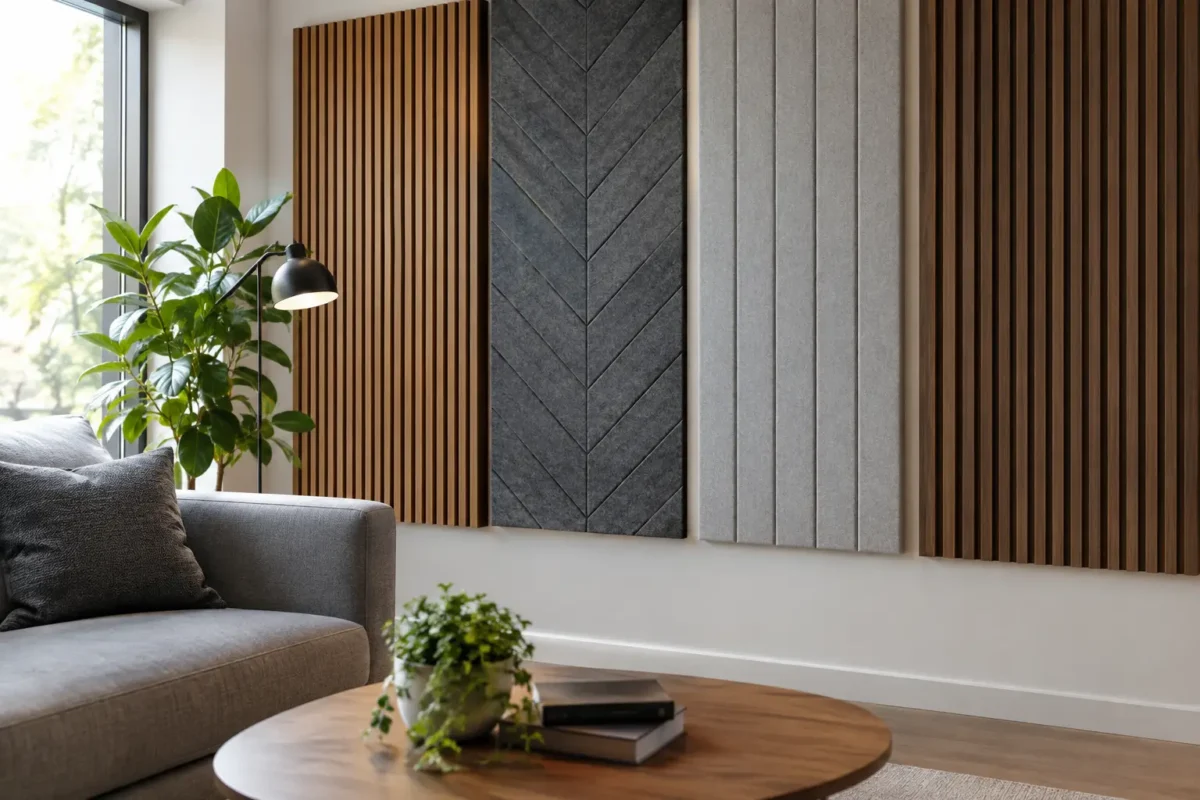
Fabric-wrapped panels are among the most effective choices where speech needs to sound cleaner. A mineral wool or acoustic foam core absorbs a broad range of frequencies, while the fabric face gives a softer, more furnished appearance. They work particularly well in home offices, cinema rooms, dining spaces, boardrooms and hospitality interiors.
Their main advantage is performance. Their trade-off is visual: unless arranged carefully, they can feel more commercial than architectural. Choosing a tailored fabric colour, creating a symmetrical layout or setting panels within decorative wall mouldings can make the treatment feel integral to the interior rather than added as an afterthought.
Slatted timber and PET felt panels for modern interiors
Slatted acoustic panels usually combine timber-faced battens with an acoustic felt backing, commonly made from recycled PET. They are popular because they bring warmth, rhythm and sound absorption to the same wall. In a lounge, bedroom, entrance hall or reception area, they can create a strong feature without looking overtly technical.
The felt backing helps absorb reflected sound, particularly when the panels are fitted over a batten cavity with acoustic insulation behind. Fitting directly to a solid wall still improves the room’s sound, but the air gap and insulation generally deliver better absorption. Check the manufacturer’s tested performance figures rather than assuming every slatted panel will perform identically.
Slatted panels are best for controlling echo, not stopping noise transmission through a party wall. They also need careful setting out around sockets, switches and external corners for a professional result.
Perforated or micro-perforated panels for larger spaces
Perforated timber, MDF or specialist composite panels suit commercial schemes, media rooms and larger residential spaces where a refined, continuous finish is required. Sound passes through the openings and is absorbed by an acoustic backing behind the panel. The result can be understated, particularly when panels are colour-matched to the rest of the joinery.
This option is often more bespoke. It needs accurate detailing at edges, junctions and access points, and the backing material is as important as the visible panel. It is a sensible route for architects, designers and fit-out teams looking for acoustic control without a soft fabric appearance.
Decorative 3D wall panels for texture, with acoustic support behind
Decorative 3D panels are excellent for adding depth, shadow and character to an interior, but hard polyurethane, MDF or plaster-effect surfaces are not substitutes for acoustic absorption. In fact, a hard decorative finish may continue to reflect sound unless it is part of a wider acoustic design.
That does not rule them out. Use 3D panels on a focal wall, chimney breast or lower wall section, then position absorptive panels where they will make the greatest acoustic difference. A ceiling treatment, fabric artwork-style panel or slatted feature on an adjacent wall can balance the scheme. Orac Decor-style lightweight wall elements are particularly useful where the visual brief calls for crisp relief and easy handling, while the acoustic treatment is specified separately.
How much acoustic coverage does a room need?
There is no useful one-size-fits-all percentage because room volume, ceiling height, flooring, glazing and furnishings all affect reverberation. A carpeted bedroom with curtains may need only a modest wall treatment. A tall, open-plan room with polished concrete, large windows and minimal furniture will need more absorption.
As a practical starting point, target the most reflective and audible areas first. In a home office, that might be the wall behind or opposite the desk. In a television room, treat the wall facing the speakers and consider the ceiling if the room remains lively. In a dining room, panels close to where people sit and talk will usually be more valuable than a small decorative panel in a distant corner.
Do not forget the ceiling. It is often the largest uninterrupted hard surface in the room, particularly in commercial interiors. If wall coverage is limited by doors, glazing or cabinetry, ceiling rafts or acoustic ceiling panels may be the more effective answer.
Detail the wall properly for lasting results
The best acoustic panel can underperform if it is installed poorly. On a solid wall, confirm that the background is dry, sound and sufficiently level. For systems using battens, use consistent spacings and keep fixings secure, especially where the installation will be subject to knocks in a hallway, restaurant or workplace.
Where the goal is sound reduction between rooms, pay close attention to gaps at perimeter junctions, electrical boxes, skirtings and service penetrations. Sound finds weak points easily. Acoustic sealant, isolated framing and a correctly specified backing layer are usually more relevant than the decorative finish alone.
Consider maintenance before committing to a surface. Fabric panels can attract dust but are often vacuum-cleanable. Timber slats need a finish appropriate to the room, particularly near kitchens. PET felt is forgiving in busy family spaces, but darker colours may be preferable where marks are likely. For decorative mouldings around the treatment, lightweight, paintable products make it easier to coordinate the final colour with walls, skirting and joinery.
Choosing panels that look at home in the room
Acoustic treatment does not need to make a home feel like an office. The most successful installations use proportion and placement. A bank of slatted panels behind a sofa can visually anchor the room. Fabric panels framed as a grid can echo the proportions of sash windows or panelled doors. A picture rail, dado detail or slim decorative profile can provide a clean transition between materials.
For period properties, avoid forcing a highly contemporary panel across every surface. Preserve existing architectural character and introduce absorption in selective zones. In modern homes, a full-height slatted wall or a sequence of upholstered panels may suit the cleaner lines of the space. The panel should support the room’s design, not compete with it.
A sensible specification checklist
When comparing acoustic wall panels, look beyond the photograph. Ask for the absorption rating and the test method used, plus the panel thickness, backing material, fire classification and recommended fixing method. Confirm whether the rating assumes direct fixing to a wall or installation over a cavity, as this can materially change the result.
Also establish what the panel is designed to solve. If it is marketed as acoustic but has a hard, thin face with no absorptive backing, it may offer limited benefit for echo control. If your concern is neighbour noise or sound leaking from a cinema room, speak to an acoustic specialist about the full wall construction before ordering any decorative surface finish.
A well-designed room should sound as considered as it looks. Choose an acoustic panel system for the performance you need, then use wall panelling, mouldings and colour to make that practical choice feel completely at home in the finished interior.
