

Home Decor
Square Edge Coving: Profiles, Uses and How to Fit It
Oct
Square edge coving is a plain, straight-sided moulding that sits where the wall meets the ceiling. It has a stepped or squared-off face instead of a curve or ornate carving. It gives a room a crisp, tailored finish. It suits contemporary and minimalist interiors, and it is a good partner for hidden lighting. If you want the softness of coving without a period look, this is the profile to consider.
Below, we explain what it is, where it works best, how to choose the size and material, and how to fit it so the corners close tightly.
TL;DR
- Square edge coving has clean, geometric lines, so it reads as modern rather than traditional. It works best in contemporary rooms, new builds and renovated flats.
- Size matters more than style. A small square profile frames a standard ceiling, while a taller room can take something deeper.
- Lightweight polyurethane is the easiest material for DIY fitting. It cuts with a fine-toothed saw, and the sharp lines stay crisp under paint.
- Accurate mitres and a good adhesive decide the result. Dry-fit every corner before you stick anything down.
- We supply Orac Decor and NOËL & MARQUET mouldings and can arrange installation through our Elite Decor UK installer network.
Table of Contents
- What square edge coving actually is
- Why choose a square profile
- Where square edge coving works best
- How to choose the right size
- Materials: polyurethane, polystyrene or plaster
- Square coving with LED lighting
- How to fit square edge coving
- Our view: why we favour plain profiles done well
- Common mistakes to avoid
- Fitted by us, or by you
- FAQ
- Sources
What square edge coving actually is
Traditional coving curves from the wall to the ceiling in a smooth concave sweep. Square edge coving replaces that sweep with straight planes and right angles, sometimes with a single step or a shallow recess. The effect is architectural rather than decorative: a neat shadow line and a defined edge, with no ornament to compete with the furniture.
You will see it called square coving, plain coving, contemporary coving or stepped cornice. The names overlap, and no single standard defines them. What matters is the shape: straight sides, sharp arrises and a simple projection.
Coving in general is a decorative join between wall and ceiling, and Wickes notes it comes in plaster, duropolymer and polystyrene. Square profiles are available in the lighter materials in particular, which is part of why they have become so popular for modern refits.
Why choose a square profile
Coving as a category softens the harsh straight edges where wall meets ceiling and adds depth and definition, according to Homebuilding. A square profile does the same job in a different spirit. Rather than softening, it frames. Here is what we see customers value most:
- A contemporary finish. The lines echo modern window frames, flat-panel doors and handleless kitchens.
- It hides imperfections. Ceilings are rarely perfectly level where they meet the wall. A moulding with a visible projection disguises hairline cracks and uneven plaster better than a bare paint line.
- It pairs with lighting. The stepped face of many square profiles leaves room for a discreet LED strip, which we cover below.
- It is easy to paint. Flat faces take a roller or brush cleanly, and crisp edges allow a sharp contrast if you want the coving in a different colour from the ceiling.
Where square edge coving works best
The profile is versatile, but it is at its best in some settings more than others.
Modern living rooms and open-plan spaces
Large, open rooms can feel a little plain once the furniture is in. A square cornice adds a clean frame at ceiling level without fussiness. If you are planning a living space, our guide to the best coving for living rooms covers proportions in more detail.
Kitchens and bathrooms
Straight-lined cabinetry and tiles pair naturally with a plain profile. Moisture-resistant polyurethane is a sensible material here, since it does not absorb water as plaster can. If you are looking for ideas on how ceiling details fit with fitted rooms, these kitchen ceiling designs show how a ceiling treatment can work with cabinetry and finishes.
Hallways, landings and bedrooms
A smaller square profile gives narrow spaces a finished edge without crowding them. In bedrooms, it creates a calm, uncluttered look that leaves the focus on the walls and soft furnishings.
Commercial interiors
Hotels, offices and restaurants often choose square mouldings because they look sharp, are quick to fit in volume and can be painted to match a brand scheme. Property managers should also note that lightweight mouldings reduce the handling risk on site.
Period homes
In a Victorian or Georgian house, a square profile can look out of place if the original rooms had ornate cornices. It can work well in an extension or a modern kitchen added to a period home, where the new space has its own character. For the more traditional look, our plaster coving alternatives are a better starting point.
How to choose the right size
The most common mistake with any coving is choosing a profile that is too small or too big for the room. A few practical rules help:
- Check ceiling height. In a standard-height room, a modest profile frames the edge without lowering the ceiling visually. Taller rooms can carry a deeper projection.
- Consider the room size. A big room with a tiny moulding looks underdressed. A small room with a bulky one feels heavy.
- Think about the lighting. If you want to hide LED strip behind the moulding, you need a profile with enough depth for the strip, or a dedicated lighting profile.
- Match the skirting. A square coving looks best with a similarly plain skirting. Our guide to skirting board styles explains how to coordinate the two.
- Order a sample. Hold it in the corner of the room, in the room’s own light, before you commit.
For a wider comparison across styles, how to choose ceiling coving for your room goes through the decision step by step.
Materials: polyurethane, polystyrene or plaster
Square edge coving is available in several materials, and each behaves differently.
| Material | Weight | Detail and crispness | Best for |
|---|---|---|---|
| Polyurethane | Light | Sharp, durable edges | DIY fitting, kitchens, bathrooms, crisp modern profiles |
| Polystyrene | Very light | Softer, can dent | Budget-led projects in dry rooms |
| Plaster | Heavy | Excellent, traditional | Period restorations, fitted by a plasterer |
For square profiles, we recommend polyurethane. Sharp edges are the whole point of the shape, and polyurethane holds them far better than polystyrene, which can dent and crumble at the arris. It is also much lighter than plaster, so adhesive does most of the work and fixing is simpler. Our comparison of polyurethane coving versus plaster sets out the trade-offs in full.
Our range includes Orac Decor and NOËL & MARQUET polyurethane mouldings, in both traditional and modern styles. You can browse them in our cornice and coving collection.
Square coving with LED lighting
One of the best uses for a square profile is indirect lighting. A strip fixed in a recess or behind a stepped moulding throws light across the ceiling, giving a soft glow without visible fittings. It works well in living rooms, bedrooms and hospitality spaces.
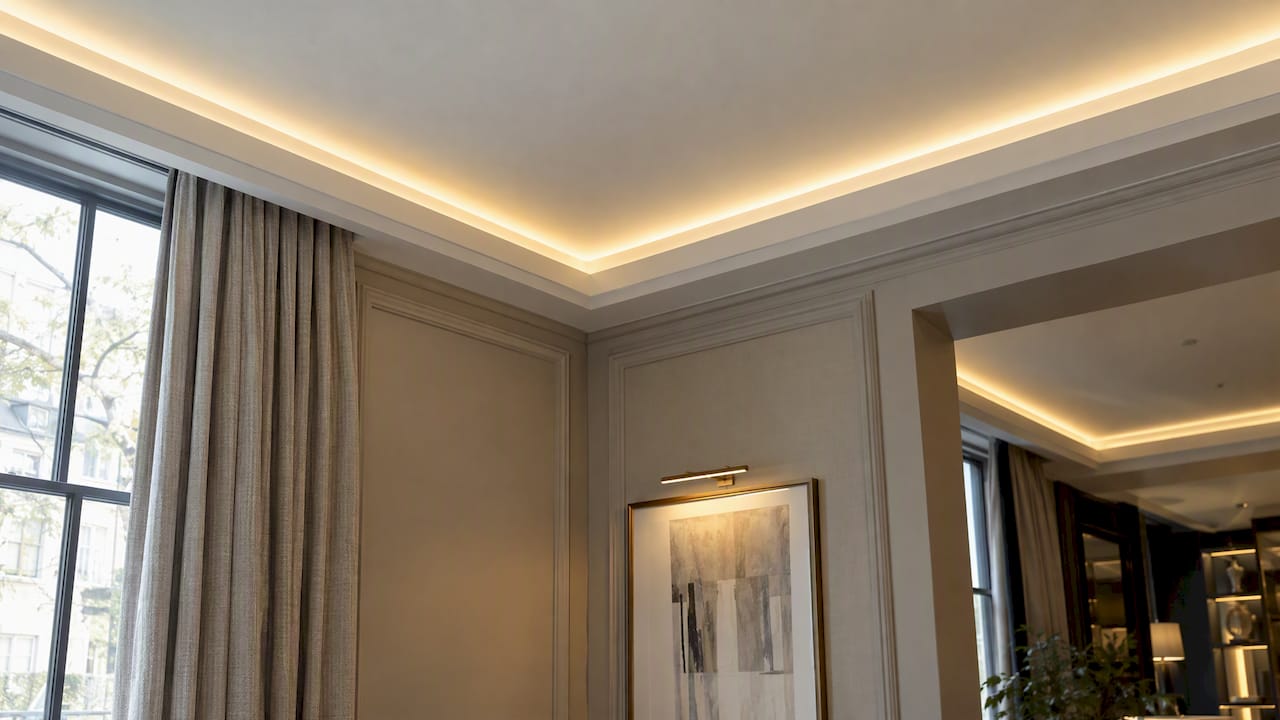
If this is what you have in mind, look at our LED coving range and our guide to Orac LED profiles and how to fit them well. Plan the cable route and driver position before the moulding goes up, not after. Our article on LED lighting in coving explains the options.
How to fit square edge coving
The method follows the standard approach for any coving, but square profiles are less forgiving. Straight lines show every gap, so accuracy counts. This is a summary, and you should always follow the adhesive manufacturer’s instructions.
What you need
- Coving lengths and a little extra for wastage
- A mitre box and a fine-toothed panel saw
- Coving adhesive and a filler for joints
- A pencil, tape measure and spirit level
- Panel pins for temporary support, if the adhesive needs it
- A damp cloth and decorator’s caulk
Step by step
- Mark a guide line. Measure the depth of the coving on the wall, then mark that distance down from the ceiling with a faint pencil line, as Evo-Stik’s coving advice suggests. It gives you a straight edge to work to.
- Prepare the surfaces. Remove loose paint and dust. Wickes advises scoring the wall before applying adhesive, which helps it grip.
- Cut the mitres. Place the coving upside down in the mitre box, so the edge that sits against the ceiling rests on the base of the box. Cut at 45 degrees with a fine-toothed saw. Wickes describes the same mitre box technique.
- Dry-fit every corner. Hold the pieces in position. Walls are rarely a perfect 90 degrees, so be ready to trim.
- Apply the adhesive. Spread a generous bead along the top and bottom contact edges, press the piece into place along your guide and wipe away the squeeze-out.
- Hold and finish. Support it temporarily if needed, fill the joints once the adhesive has set, and let the caulk cure before painting.
Carl’s Installer Tip
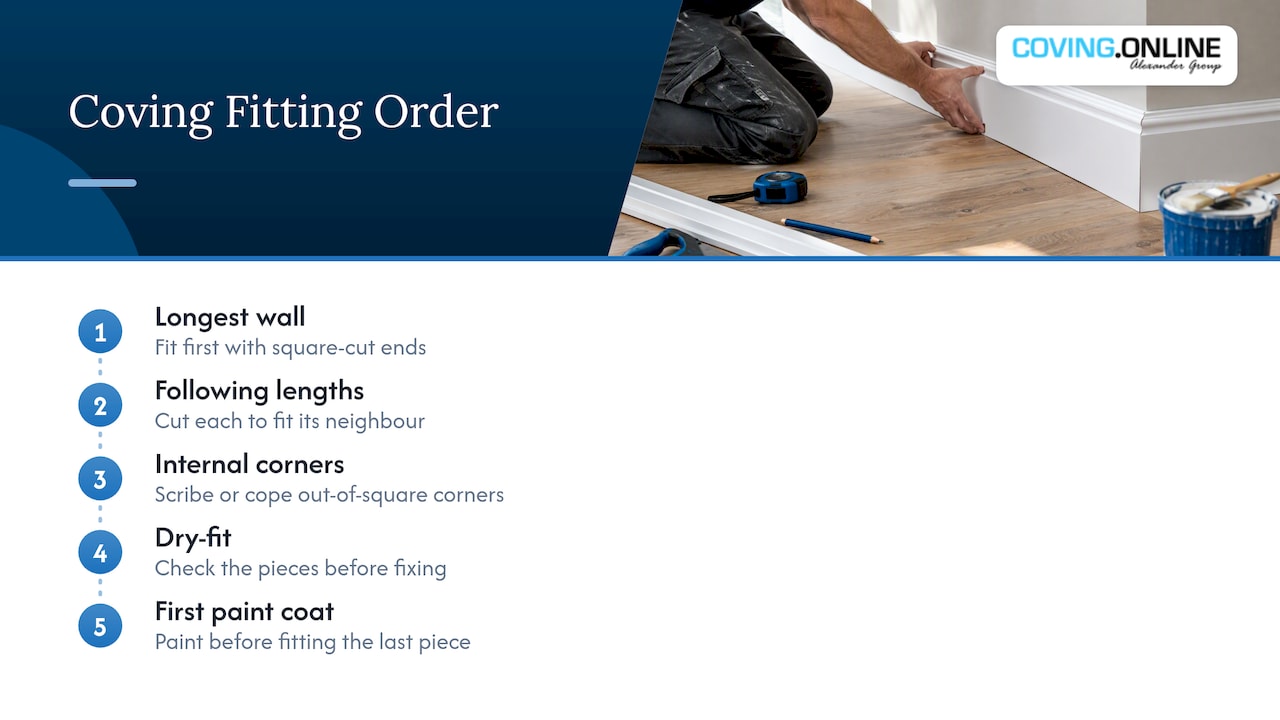
In our experience, the most common mistake with square coving is cutting the internal mitres first and measuring afterwards. We’ve found it far better to fit the longest wall first with square-cut ends, then cut each following piece to fit its neighbour. Square profiles show every gap, so a coping or scribe cut at internal corners often looks better than a pure mitre in an out-of-square room. Always dry-fit, and paint the first coat before you fit the last piece, so you are not cutting in at the ceiling with a brush.
Our view: why we favour plain profiles done well
We supply and fit mouldings across the whole Orac Decor and NOËL & MARQUET range, so we see what works in real homes. The pattern is consistent. People often choose ornate cornice because they fear a plain one will look cheap. In practice, a well-proportioned square profile looks more expensive than an over-scaled decorative one, because the finish does the talking.
The quality of the fitting matters more than the choice of profile. A plain moulding with tight corners and clean paint lines looks deliberate. A slightly gappy mitre looks careless.
We also think square coving is under-used with lighting. Many people choose a plain cornice and add a lighting profile later, which means cutting and re-decorating. If you may want indirect light, decide before the moulding goes up.
Our advice is to order a sample and look at it in your own room in the morning and evening light. Then choose the size that suits the ceiling height, not the one that looks best on a screen.
— Carl
Common mistakes to avoid
- Choosing a profile that is too small. It will look like an afterthought on a big ceiling.
- Skipping the guide line. Even a slight slope shows clearly against a straight edge.
- Forcing a mitre in an out-of-square corner. Trim to the actual angle instead.
- Using the wrong adhesive. Use one made for coving, not general-purpose filler.
- Painting before filling. Fill joints and let them dry, then sand lightly and paint.
- Forgetting the rest of the room. Think about the skirting, door surrounds and ceiling rose so the scheme hangs together. Our skirting range and ceiling roses are worth a look.
Fitted by us, or by you
Plenty of homeowners fit lightweight coving themselves, and polyurethane is forgiving if you take your time. If you would rather not, or the job involves high ceilings, stairwells, a lot of corners or lighting, we can arrange a professional through our Elite Decor UK national installer network. That means one point of contact from choosing the profile to the finished room.
Ready to start? Browse our cornice and coving collection, pick up adhesives and tools, or ask us about installation.
FAQ
Is square edge coving suitable for a standard UK ceiling?
Yes. A small or medium square profile suits a standard-height ceiling well. Choose a depth that frames the edge without visually lowering the room, and check it with a sample before you order.
Can I fit square edge coving myself?
Yes, if you are comfortable measuring and cutting accurately. Lightweight polyurethane is the easiest material. Mark a guide line, cut your mitres in a box, dry-fit every corner and use a proper coving adhesive.
Does square coving work with LED lighting?
Often, yes. Stepped profiles can leave room for a strip, and dedicated lighting profiles are made for the job. Plan the cable and driver positions before fitting, and see our LED coving range.
Is square edge coving too modern for an older home?
It can be in a room with original ornate features. It suits extensions, kitchens and renovated rooms better. For period rooms, a decorative curved or detailed cornice usually looks more in keeping.
Sources
- How to install coving to add a touch of period charm, Homebuilding
- How to Put up Coving, Wickes
- How to apply coving, Evo-Stik
Recommended
- Preformed Coving Corners for Cleaner Finishes
- Vaulted ceiling coving: profiles, cutting and fixing tips
