
Home Decor
Trade Ready Commercial Coving: LED Ready and Wipe Clean Solutions

Sep
For most commercial fit-outs, the practical answer is lightweight polyurethane coving in a stepped or linear profile, specified LED-ready from the outset. It survives high footfall, takes a wipe-clean cladding trim where hygiene matters, and integrates COB LED strips for the ambient ceiling wash that has become standard in offices, retail and hospitality. The sections below cover the styles, materials, LED specification and installation detail you need to brief a contractor with confidence.
TL;DR:
- Polyurethane coving is the preferred choice for commercial projects due to its lightweight, flexibility, and suitability for LED integration, unlike heavier plaster or less durable polystyrene.
- Modern coving styles include plain, stepped, linear shadow-gap, curved, and feature bands, selected based on room function and desired architectural effect.
- Proper LED specification requires COB strips with CRI 90 or above, correct lumen and driver calculations, and early control protocol planning to ensure a seamless and even wash.
- Accurate site measurement, batch ordering, and deliberate joint planning are essential for consistency and a professional finish across large or multiple-room projects.
- For hygiene-critical spaces, wipe-clean cladding trims with fire-rated certifications are recommended, and sample testing before large orders helps avoid shade mismatch and installation issues.
Table of Contents
- Modern coving styles and design ideas for commercial interiors
- Materials and durability: specifying coving for commercial use
- LED coving and indirect uplighting: the technical checklist
- Practical installation and specifying guidance for trade-scale projects
- Hygiene, fire and durability in commercial rooms
- Design examples, placement and typical dimensions
- Coving.Online solutions and trade support for commercial projects
- Author perspective: coving trends in commercial refurbishment
- How Coving.Online can help with samples and installation
- Sources
Modern coving styles and design ideas for commercial interiors
Commercial coving has moved well past the plain quarter-round profile you’d find in a 1990s office block. The style you choose should do a job, whether that’s softening a corridor, concealing services, or reinforcing a brand identity at the point of sale.
Plain cove remains the quiet workhorse. A shallow, unadorned radius suits open-plan offices and corridors where you want the ceiling line to disappear rather than announce itself. It’s the profile to specify when the coving’s role is purely to finish the junction cleanly.
Stepped coving earns its keep in retail and hospitality. The stepped profile throws a deeper shadow line than a plain cove, which reads well in circulation spaces, entrance lobbies and anywhere you want a stronger architectural gesture. Suppliers now group their modern coving ranges around exactly this distinction, and stepped profiles are frequently the default recommendation for commercial settings.
Other directions worth briefing into a scheme:
- Linear shadow-gap or pelmet coving for minimalist, branded interiors, where the goal is a crisp negative line rather than a visible moulding, often used to conceal cabling or curtain tracks.
- Curved and flexible coving for reception desks and bespoke retail counters. Flexible polyurethane runs around radiused walls without the cracking you’d risk with plaster.
- Feature bands and colour-drenched coving for wayfinding and brand colour integration, where the coving becomes part of the ceiling’s colour block rather than a neutral trim.
- Pre-formed dry-lining coving panels, which retrofit into both contemporary and period buildings with far less site disruption than wet plaster methods.
If you’re coordinating a scheme that also involves curtains or pelmets over a reception window, it’s worth looping in a soft furnishings specialist such as The Perfect Stitch early. Getting the pelmet depth and the coving shadow line to work together at design stage avoids an awkward clash on site.
Materials and durability: specifying coving for commercial use
Material choice is where commercial coving projects succeed or fail, because domestic assumptions about weight, fixing and finish don’t transfer well to high-traffic buildings.
- Plaster gives you the most authentic period profile and remains the right call for heritage conservation work, but it’s heavy, brittle in transit, and unforgiving of the movement you get in busy commercial buildings. Reserve it for genuinely period-sensitive projects rather than general commercial fit-outs; our period style coving guide covers where it still earns its place.
- Polyurethane, the material behind Orac Decor and NOËL & MARQUET ranges, is lightweight, pre-primed and flexible enough to follow slight wall movement without cracking. It typically needs only one coat of paint on site, which matters when you’re paying trade labour by the hour across dozens of rooms. It’s also the material that takes LED profile integration cleanly, which is why it’s become the trade-preferred choice for most commercial projects.
- Polystyrene (EPS) coving is cheap and light, but it dents easily, doesn’t hold paint well over time, and carries fire performance concerns that make it a poor fit for high-traffic or public areas. Avoid it for anything beyond the lowest-budget domestic job.
- PVC and cladding trims are the right answer wherever the room gets washed down. Precast coving trims eliminate mitre cutting entirely, which speeds up multi-room fit-outs and removes the joint-quality variance you get between different installers on a large site.
Whatever material you land on, request the fire-rated datasheet before you commit to a bulk order. Building regulations vary by use class and by the specific space (a commercial kitchen has different requirements to an open-plan office), so confirm the product’s fire classification against your project’s actual requirement rather than assuming a general-purpose rating covers you.
LED coving and indirect uplighting: the technical checklist
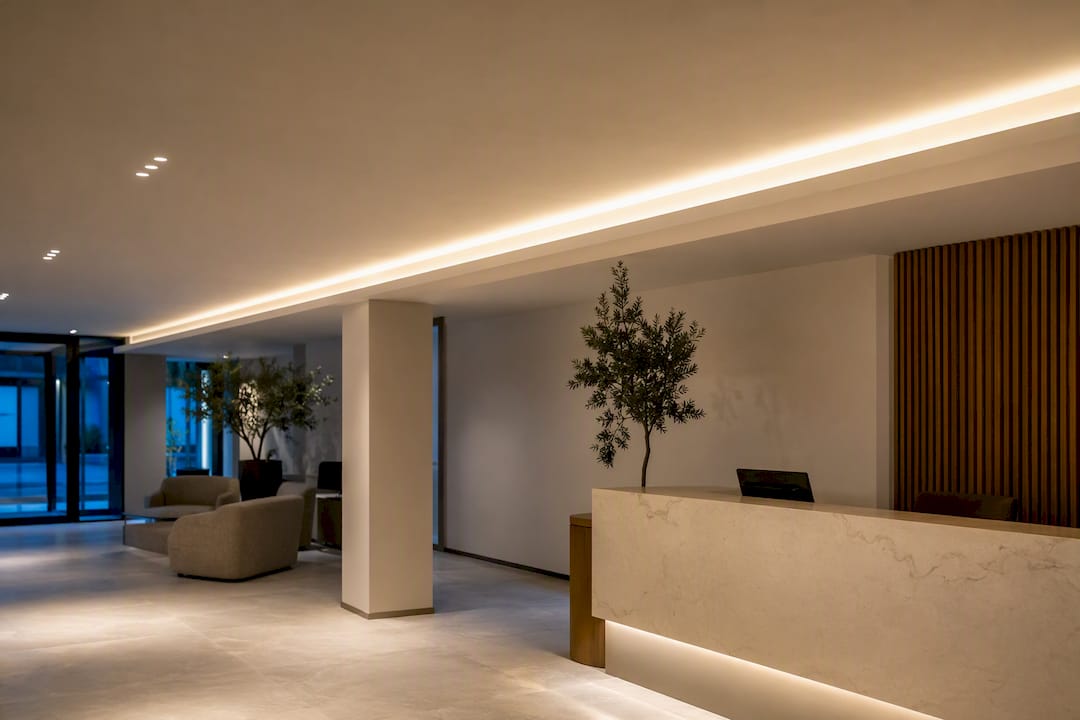
The design brief for LED coving is almost always the same: a continuous, even wash of light along the ceiling line, with no visible lamp dots and no hotspots. Getting there is a specification exercise, not a lighting afterthought bolted on at the end.
- Fix the design aim first. You want a homogeneous glow that reads as architecture, not a strip of individual LEDs you can count from across the room.
- Choose COB over SMD wherever budget allows. COB (chip-on-board) strips produce a genuinely seamless line of light, which is the professional standard for coving applications; SMD strips are acceptable for lower-spec or budget-constrained runs but will show more banding.
- Specify CRI 90 or above for any hospitality or retail space where colour accuracy matters, whether that’s food display or fabric samples. Pair it with a colour temperature of roughly 2700 to 4000K, biased warmer for hospitality and cooler for offices needing task-supportive ambience.
- Calculate lumens per metre and driver load properly before ordering. Long continuous runs generate real heat, so factor in the aluminium profile’s role in heat dissipation rather than treating it as decorative trim.
- Decide on control protocol early. DMX or KNX suits larger commercial schemes needing scene-setting; DALI integrates more readily with an existing building management system. Retrofitting control after first fix is expensive and disruptive.
- Plan service access into the coving run. Long runs need intermediate driver positions and access points, not a single driver feeding sixty metres of strip.
Pro Tip: In our experience, the single biggest cause of a patchy LED coving wash is contractors running strip lengths that exceed the driver’s rated distance to save on driver costs. Spec the driver positions on the drawing before first fix, not after the electrician has already run the cable.
Practical installation and specifying guidance for trade-scale projects
Consistency across multiple rooms, floors or sites is the real challenge on commercial coving jobs, far more than the installation of any single run.
- Survey every perimeter run properly before ordering, and dry-fit long lengths on the floor first. Start marking out from the longest wall in the room; that’s where cumulative measuring error does the most damage if you get it wrong.
- Batch order generously. Production runs can vary slightly between batches, and a mismatched shade halfway along a 40-metre corridor is far more visible than most people expect. Order enough from a single batch to cover the whole run, plus a margin.
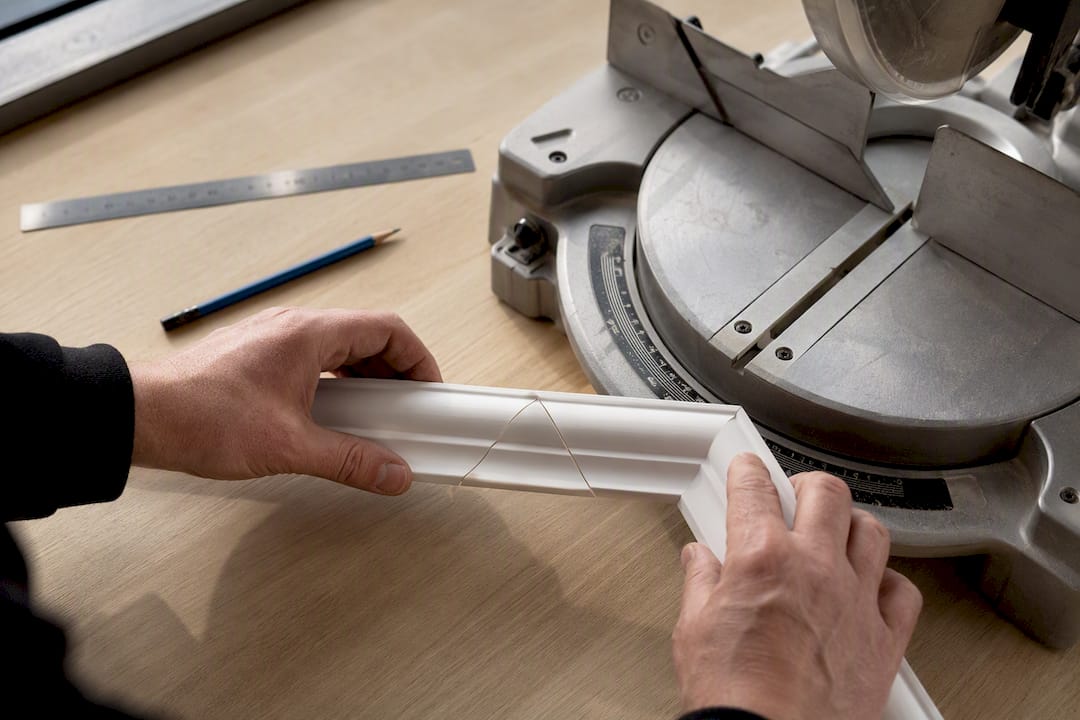
- Tools worth having on the van: a decent mitre saw or a Wonder Mitre-style template, coving adhesive, panel pins for temporary support while adhesive cures, and an angle finder for the corners that are never quite 90 degrees in a real building.
- Plan your joins deliberately. Use butt joints along long straight runs where the profile allows it, and mitre joins at corners; fill and caulk every joint before the final paint coat rather than after.
- Sequence the trades properly. Let adhesive cure fully before painting, and coordinate with the electrical team on LED coving runs so cable routes and access panels are agreed before the coving goes up, not after.
Buying an extra length for practice cuts and testing paint match on a sample piece before committing to a full-room order is standard trade practice for good reason.
Pro Tip: We’ve found that fitters who rush the corners on a first-fix visit end up back on site twice as often. Cut one test mitre on an offcut for every genuinely non-square corner in the room before touching the good length. Commercial corners are rarely as square as the drawings suggest.
Hygiene, fire and durability in commercial rooms
Kitchens, washrooms and clinical spaces need a different answer to an open-plan office, and this is where cladding coving trims justify their place in the specification.
- Wipe-clean cladding trims hold their colour and never flake the way a painted plaster or polyurethane surface eventually can under repeated cleaning cycles, which is why they’re the right call for commercial kitchens and washrooms.
- Check compatibility with your panel system. Confirm the trim works with any fire-rated wall or ceiling board you’re specifying, and check the manufacturer’s guidance on chemical cleaning agents, since grease-cutting products in commercial kitchens can degrade some finishes over time.
- Build a maintenance schedule in from day one. High-traffic corridors and food-prep areas need a defined cleaning regime and periodic inspection, not an assumption that cladding trims are maintenance-free forever.
Design examples, placement and typical dimensions
Ceiling height and room function should drive the profile size, not aesthetic preference alone.
- Low ceilings (2.4m or under): keep projection and drop shallow, roughly 60 to 90mm, so the coving doesn’t visually lower the room further.
- Standard commercial ceilings (2.4 to 3m): a 90 to 120mm profile reads comfortably and gives enough depth for LED integration without dominating the room.
- High ceilings (over 3m): you can go bolder, 150mm and above, particularly with stepped profiles that need the extra height to throw a visible shadow.
A few zoning notes worth handing straight to a contractor: lobbies generally work best with a continuous cove and warm 3000K LED for a welcoming arrival sequence; boardrooms suit a single restrained feature band with a neutral 3500K wash that won’t distort presentation colours; back-of-house corridors are the natural home for stepped coving, which conceals containment and pipework without extra ceiling void depth.
Coving.Online solutions and trade support for commercial projects
Coving’s product range is built around exactly the specification points above. Our Orac Decor and NOËL & MARQUET polyurethane ranges cover plain, stepped and linear profiles, with LED-ready channel options and flexible variants for curved runs, so you’re rarely forced to compromise the design brief to fit the material.
- Product fit: Orac Decor and NOËL & MARQUET ranges give you pre-primed, trade-ready profiles across most of the styles covered above.
- Trade services: sample posting so you can test paint match and finish before bulk ordering, specification support for multi-room schedules, and access to the Elite Decor UK installer network for nationwide fitting.
- Batch consistency: ordering through a trade account helps avoid the shade variance that catches out contractors buying piecemeal from multiple sources.
Carl’s Installer Tip: In our experience, the projects that run smoothest are the ones where the sample arrives on site before the bulk order is confirmed. Test the LED colour temperature against the actual profile finish under real site lighting, not under a showroom spotlight; it changes how warm or cool the wash reads.
Author perspective: coving trends in commercial refurbishment
LED-ready coving has stopped being a novelty add-on and become the default brief on most commercial refurbishments I see specified now. Five years ago it was a premium extra; today, clients ask why a scheme doesn’t include it. That shift changes the profile decision at the very start of a project, because you’re no longer retrofitting a channel into a moulding designed for something else.
The genuine skill lies in restraint. Period buildings still deserve plaster detail where the architecture calls for it, but bolting heavy traditional profiles onto a contemporary office fit-out usually looks apologetic rather than characterful. Polyurethane lets you borrow the shadow lines of traditional coving without the weight, the fragility or the fixing headaches, which is precisely why trade specifiers keep returning to it.
If you’re weighing up profiles for a live commercial brief, get in touch with Coving.Online for specification advice or a sample pack; it’s a faster route to the right answer than guessing from a catalogue image.
— Carl
How Coving.Online can help with samples and installation
Coving is the practical route to the profiles covered in this piece: Orac Decor and NOËL & MARQUET polyurethane ranges, LED-ready channels, flexible curved sections and wipe-clean cladding trims, all available through a trade account with fast UK-wide delivery.
If you’re specifying for a live commercial job, start with samples rather than a catalogue guess. Order sample lengths to test paint match and LED colour rendition on-site, request a trade quote for batch pricing across multiple rooms, or book an installation survey through the Elite Decor UK network if you’d rather hand the fit to trusted fitters. Head to Coving to get the specification process moving, or browse the full Orac Decor range to shortlist profiles before your next site meeting. It’s also worth checking a supplier’s trade reputation before committing to a large commercial order, whoever you buy from.
Sources
For deeper technical detail behind the recommendations above: Lighting Line’s LED coving guide covers COB versus SMD specification in more depth; Celplas’s cladding trim guide is the clearest resource on hygiene-critical installation; and Ideal Home’s installation walkthrough sets out the mitring technique referenced throughout this article.
