

Home Decor
Skirting Board Styles: 4 Decisions Homeowners Need, Installer Tips
Sep
Traditional homes suit ornate profiles like ogee and torus, while modern spaces call for square edge, chamfered, or flush skirting. Getting it right comes down to four decisions: profile shape, height, material, and finish. Period rooms with generous ceilings can carry a bolder profile; new builds with lower ceilings usually look better with something cleaner and less fussy.
TL;DR:
- Ornate profiles like ogee and torus suit high-ceiling Victorian or Georgian homes better than modern, low-ceiling spaces, which benefit from cleaner, simpler designs.
- MDF is the most common and cost-effective material for painted skirting, but hardwood offers authenticity for restored period homes, while PVC is suitable for damp areas.
- Skirting height should be around 5 to 7% of ceiling height to maintain visual balance, with 150 to 200mm being standard for Victorian rooms and 100 to 150mm for modern builds.
- Matching profiles across connected rooms or hallways is recommended, keeping height differences between 20 to 30mm for a cohesive appearance.
- High-end minimalist schemes benefit from flush or shadow gap skirting, which require precise installation during build and are difficult to retrofit afterward.
Table of Contents
- Skirting board styles explained: the main profiles and what they suit
- Matching profiles to interior style and room proportion
- Skirting board materials: MDF, timber, and PVC compared
- Skirting board height and proportion: the numbers that matter
- Flush skirting and shadow gap: the minimalist alternative
- How to choose your skirting: a practical checklist
- Our take: when a DIY fit works and when to call in a professional
- Get the right skirting for your project
- Sources
Skirting board styles explained: the main profiles and what they suit
Every skirting profile has a job to do, both visually and practically. Some catch shadow and add depth; others stay deliberately quiet so the wall reads as one clean plane. Here’s how the most common profiles break down.
- Ogee — an S shaped curve that catches light beautifully in a room with cornicing or ceiling roses. Typically 120 to 200mm high, made in MDF or timber, and a natural fit for Victorian and Edwardian interiors.
- Torus — a rounded, convex profile with a bold, chunky presence. Common in Georgian and Victorian houses at 150 to 200mm, and one of the profiles designers recommend for tall period rooms.
- Ovolo — a softer, quarter-round curve that’s less dramatic than ogee but still has character. Sits well in Edwardian and Arts and Crafts homes, usually 120 to 170mm.
- Bullnose — a simple, fully rounded top edge with no sharp lines. Easy to clean, forgiving on paint, and a good middle ground between period and contemporary.
- Chamfered — a flat, angled cut along the top edge. Clean but not stark, and a favourite in modern and transitional interiors at 90 to 150mm.
- Square edge — a flat, unadorned top with crisp lines throughout. The default choice for new builds and minimalist schemes, and widely used because it’s cost-effective and takes paint beautifully.
- Lamb’s tongue — a small decorative curl near the top edge, subtler than ogee. Suits cottages and modest period properties wanting a touch of detail without heaviness.
- Shadowline — a slim, recessed groove that creates a thin shadow line instead of a visible board edge. Popular in high-end contemporary schemes at 15 to 20mm gaps rather than conventional heights.
Trade guides consistently group these seven or eight profiles together as the core vocabulary anyone choosing skirting needs to know.
Matching profiles to interior style and room proportion
Getting the pairing right is mostly about reading the room you already have, not imposing a look on it.
- Victorian and Georgian homes: ogee or torus at 150 to 200mm balances high ceilings and period cornicing.
- Edwardian homes: ovolo or lamb’s tongue at 120 to 170mm suits slightly less ornate detailing.
- New builds and modern extensions: square edge or chamfered profiles at 90 to 150mm, sometimes stepping up to shadow gap for a fully minimal look.
- Mid-century and transitional interiors: chamfered or bullnose profiles strike a balance between softness and simplicity.
- Connected rooms: keep the same profile family running through a hallway and its adjoining rooms, even if the height changes slightly between them.
Designers and carpenters commonly recommend taller, ornate profiles to anchor a room with high ceilings, while slimmer profiles suit open-plan contemporary spaces where the wall needs to feel continuous rather than framed.
Pro Tip: If you’re mixing profiles between a hallway and a living room, keep the height difference to no more than 20 to 30mm. A bigger jump makes the transition look like an afterthought rather than a considered choice.
Skirting board materials: MDF, timber, and PVC compared
Material choice affects durability, cost, and how well a profile actually holds its shape once it’s painted.
- MDF, primed: the most common choice for painted schemes. Affordable, dimensionally stable, and available in both softer-radius and crisp square-edge variants for square edge skirting specifically. Needs sealing if it’s going anywhere near sustained moisture.
- Softwood: cheaper than hardwood and easy to stain or paint, though it dents more easily and can show grain movement over time.
- Hardwood: the choice for heritage authenticity, especially in older houses being restored close to original specification. Costs more but takes a natural stained finish that MDF can’t replicate.
- PVC and polystyrene: lightweight and genuinely moisture resistant, which makes them useful in bathrooms and utility rooms. MDF needs sealing in wet areas, while PVC handles damp without complaint, though it lacks the visual depth of real timber.
On finish: painted MDF in a tonal shade close to the wall colour keeps a room feeling calm, while a contrasting white against a darker wall gives sharper definition. If you’re pairing skirting with wood doors, it’s worth knowing that trim doesn’t need to match door colour exactly to look coherent.
Skirting board height and proportion: the numbers that matter
Getting height right is largely a matter of proportion, not personal preference.
- Standard UK skirting typically runs 100 to 150mm for average ceiling heights around 2.4m.
- Rooms with ceilings above 2.7m generally suit 150 to 200mm boards, particularly with ogee or torus profiles.
- A rough proportional rule: skirting height at roughly 5 to 7% of total ceiling height keeps things visually balanced.
- Check clearance against door architraves and existing window sills before finalising a height, especially in older houses with uneven floors.
Design guidance consistently puts ornate profiles at 150 to 200mm specifically for Victorian rooms with generous ceiling heights, which is the clearest benchmark available if you’re working with a period property.
Flush skirting and shadow gap: the minimalist alternative
Flush skirting sits recessed into the wall so no board edge is visible; shadow gap creates a thin dark line instead of a conventional profile. Both give a wall an uninterrupted, almost floating look that period profiles simply can’t achieve.
- Best specified at the build or major renovation stage, since retrofitting into existing plasterwork is often costly and impractical.
- Worth the investment in high-end contemporary schemes where a seamless wall plane is the whole point.
- Shadow gap and flush details are strong architectural choices but rarely straightforward outside new-build conditions.
- Bring in a professional installer for either option. The tolerances involved leave very little room for error.
How to choose your skirting: a practical checklist
Before you order anything, work through these steps in order.
- Measure your ceiling height, door reveals, and window sill depth, and write them down against the room name so you don’t mix them up later.
- Order physical samples of your shortlisted profiles and hold them against your skirting, architrave, and flooring samples in natural daylight, not just under artificial light in the evening.
- Ask your supplier about lead times, especially for hardwood or bespoke profile runs, which can take considerably longer than stocked MDF.
- Ask an installer how they’ll handle corners, uneven walls, and existing pipework before you commit to a quantity.
Testing samples in situ against your existing architrave and flooring before ordering a full run is one of the simplest ways to avoid an expensive reordering mistake.
Carl’s Installer Tip: In our experience, the single biggest fitting mistake is cutting internal corner joints at a flat 45 degrees on walls that aren’t actually square, which almost no wall is. We always scribe or cope the joint by hand rather than trusting a mitre saw alone. We’ve also found that skipping a dry run of the full run around the room, before any adhesive goes near the wall, is how people end up with a short board and a visible joint in the worst possible spot.
Our take: when a DIY fit works and when to call in a professional
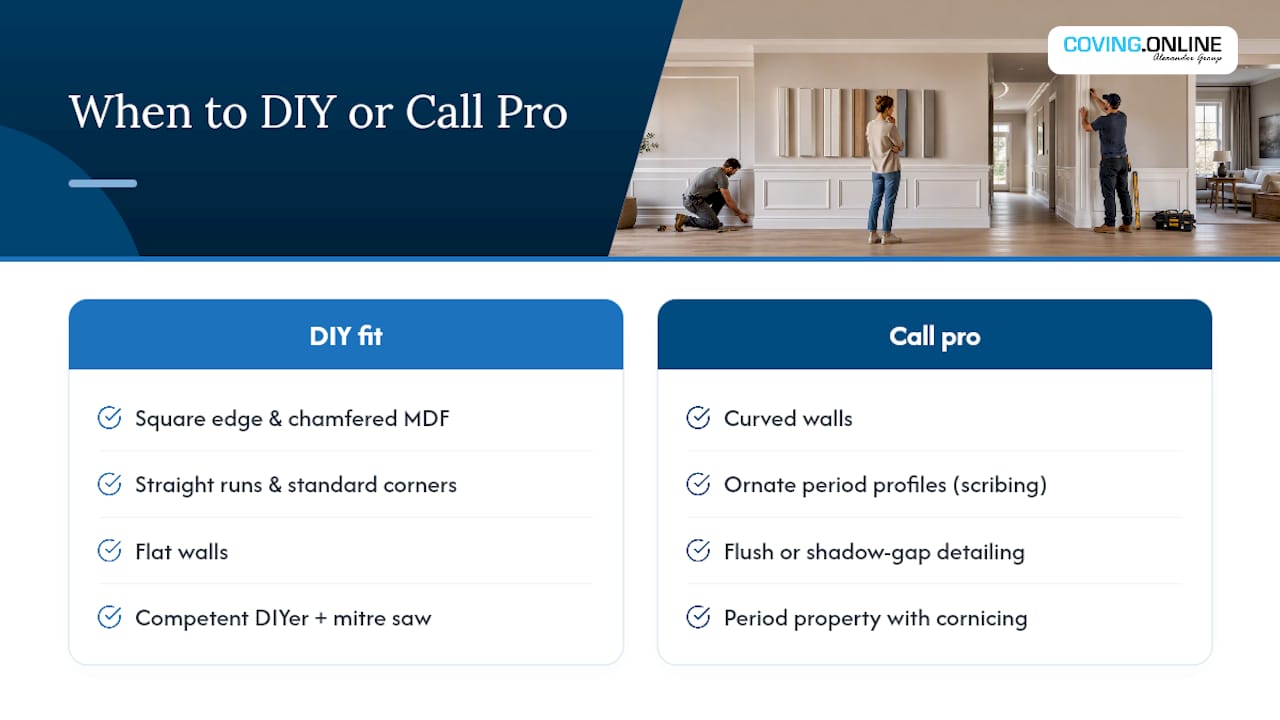
Square edge and chamfered profiles in MDF are genuinely forgiving for a competent DIYer with a mitre saw and some patience. Straight runs, standard corners, and a flat wall are well within reach for most homeowners.
Where it gets harder is anything involving curved walls, ornate period profiles that need scribing to an uneven original skirting line, or flush and shadow-gap details that depend on precise plasterwork tolerances. That’s where Coving’s Elite Decor UK installer network earns its keep, alongside the range of Orac Decor and NOËL & MARQUET profiles we supply. If your project involves a period property with existing cornicing, or a new-build wanting flush detailing done properly, get a quote before you buy materials rather than after.
— Carl
Get the right skirting for your project
Coving gives you access to over 500 Orac Decor and NOËL & MARQUET mouldings, from crisp square edge MDF for a contemporary extension through to period-accurate ogee and torus profiles for a Victorian terrace, all without the guesswork of matching profiles from a generic trade catalogue.

You can order physical samples before committing to a full room run, which matters more than most people expect once a profile is sitting against your actual wall colour and flooring rather than a photo on screen. If a project needs proper fitting, particularly flush skirting, shadow gap, or period profiles on uneven period walls, our Elite Decor UK installer network can quote and book the work directly. For advice on pairing skirting with existing flooring, our guide on skirting with carpet is worth a read too. Head to the Coving product ranges to request samples or a quote for your room.
Sources
- How to match your skirting board to your interior style | Homebuilding
- Types of Skirting Board Profiles | Skirting designs & styles explained
- Square Edge MDF Skirting & Architrave Mouldings | SAM
