

Home Decor
Fireplace Mouldings: Styles, Materials and Safe Fitting

Nov
Fireplace mouldings are the profiled trims, panels and surrounds that frame a chimney breast or mantel. For most UK homes the best result comes from lightweight polyurethane profiles, chosen to match the architecture of the room and fitted to the fire manufacturer’s clearances. We supply Orac Decor and NOËL & MARQUET profiles and can arrange fitting through our Elite Decor UK installer network, so the choice, the supply and the fitting stay in one place.
TL;DR
- Choose the profile to suit the house: crown, dentil and egg-and-dart for period rooms, flat or square-edged trims for modern ones.
- Polyurethane mouldings reproduce fine detail, are light and easy to handle, and resist warping or cracking.
- Check the fire or stove manufacturer’s instructions for distances to combustible materials before you fix anything near the opening.
- Fix surrounds mechanically to the wall. Adhesive alone is not acceptable for surrounds under NHBC standards.
- Dry-fit every piece first, then fix, fill and paint.
Table of Contents
- What counts as a fireplace moulding
- Choosing a style for your room
- Which material suits a fireplace moulding
- Safety first: heat and clearances
- Fixing a surround properly
- How to fit decorative fireplace mouldings
- What do fireplace mouldings cost
- Our view
- Start your fireplace project
- FAQ
- Sources
What counts as a fireplace moulding
The term covers several things. There are the profiles that dress a mantel shelf, the trims that frame the opening, and the wider decorative panelling on the chimney breast above. Some homeowners add all three for a layered look. Others use a single moulding to tidy the junction between a surround and the wall.
Common mantel profiles include crown, dentil, egg-and-dart, cove and quarter-round. The same source advises that the choice should follow the home’s architectural style, its existing trim and the size and proportion of the fireplace. A deep, heavily detailed profile on a small chimney breast will overpower it. A thin profile on a wide one will look lost.
If you want a shadow line, which adds depth without extra bulk, you can offset layers of moulding, contrast two profiles or recess a panel. It is a simple way to frame the space and introduce rhythm to a flat wall.
Choosing a style for your room
Traditional and period homes
Georgian and Victorian rooms suit crown profiles, dentils, fluted details and rosettes. Classic schemes typically lean on these elements, often painted rather than stained. If the room already has coving and a ceiling rose, carry the same character down to the fireplace so the room reads as one design. Our guides to choosing skirting boards for period homes and ceiling roses help you keep the details consistent.
Contemporary rooms
Modern fireplaces usually want restraint. Flat stock and square-edged profiles, or a plain plaster-style finish, keep the focus on the fire. A shallow-lip bolection moulding near the opening, or flat square trim near the firebox, keeps the look crisp. Pair this with wall panelling on the chimney breast for a calm, architectural feature. Our wall panelling range and 3D wall panels both work here.
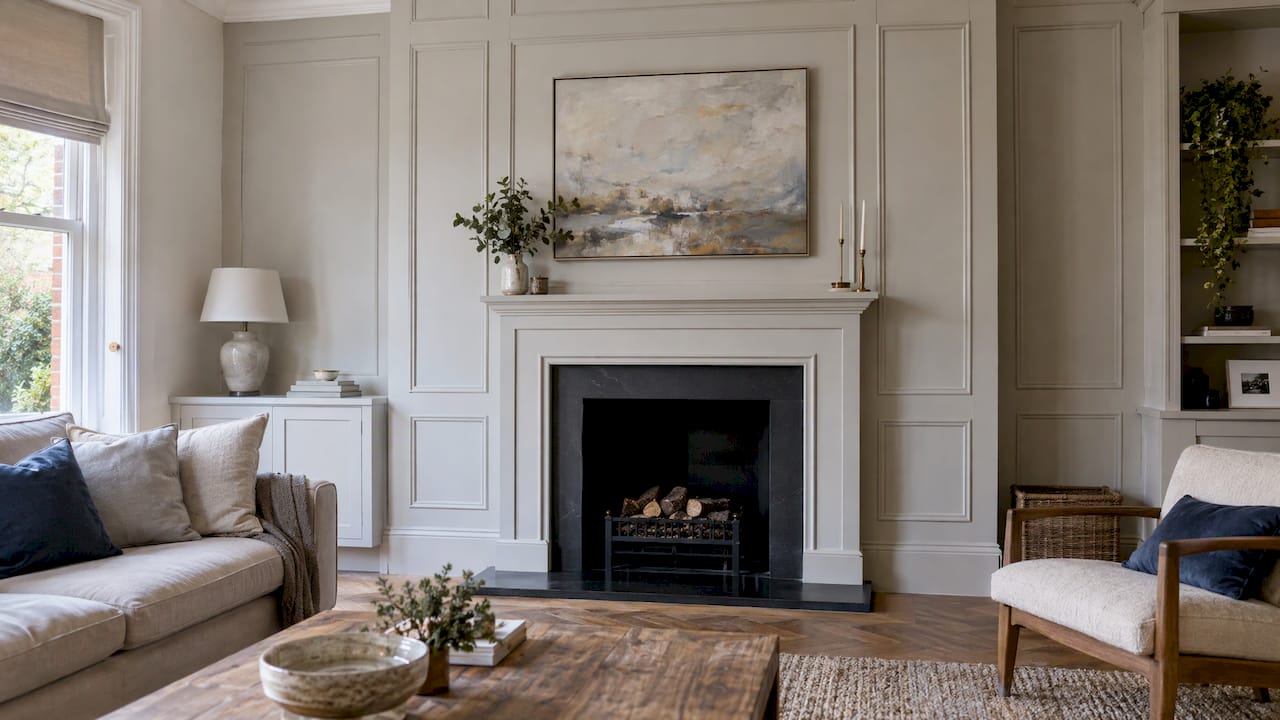
Ornate and statement schemes
For a more theatrical look, French-inspired schemes use acanthus leaves, egg-and-dart and gilded or heavily painted finishes. Polyurethane suits this because it holds fine relief detail crisply, and the finished piece is far lighter than carved wood or stone.
Which material suits a fireplace moulding
| Material | Look and feel | Points to know |
|---|---|---|
| Polyurethane | Crisp detail, paints well | Light, cost-effective, easy to install and resists warping or cracking |
| MDF | Smooth, flat, paint-ready | Lighter and cheaper than natural wood; some grades are fire-retardant |
| Solid wood | Warm, can be stained | Needs sealing and carpentry skill for neat joints |
| Plaster | Seamless, classical | Heavy, fragile in transit, needs skilled fitting |
| Stone and marble | Very durable | Heavy; a structural job as much as a decorative one |
For most homeowners and DIYers, polyurethane is the practical choice. It cuts cleanly, takes paint without fuss and does not ask a wall to carry much weight. That is why our range is built around Orac Decor and NOËL & MARQUET polyurethane profiles. For a wider look at how materials behave in British homes, see our guide to the best materials for coving and cornice in the UK climate, and for the budget end, our piece on MDF coving.
Safety first: heat and clearances
A fireplace is a heat source, so the moulding must be matched to the appliance. This is the part of the job that should never be guessed.
HETAS, the UK body for solid fuel and biomass heating, says that before any surround installation the manufacturer’s instructions supplied with the fire must be read. Minimum distances to combustible material, such as surround legs and overhangs, vary from one appliance to another. The same guidance says builder’s openings should be adjusted with non-combustible material such as brick or concrete blockwork.
To show how specific these figures are, one UK gas fire installation guide requires 100mm at either side of the fascia to a combustible surface, and 150mm from the top of the fascia to any shelf, with extra allowance for deeper shelves. Your appliance will have its own numbers. Use those, not these.
In practice:
- Keep decorative mouldings outside the clearance zone around the opening.
- Use shallow profiles where clearance is tight, and keep dentils and deep returns for the shelf or the wall above.
- For a wood burner or open fire, confirm the heat rating of any adhesive and filler you use near the opening with the appliance manufacturer. Fire safety work on a live appliance should be done by a registered engineer.
Fixing a surround properly
For surrounds, the standard is clear. NHBC Standards 2026 require surrounds and fixings to be installed by competent operatives per the manufacturer’s specification, using mechanical fixings, and not adhesive alone. HETAS likewise says the ‘dot and dab’ adhesive method must never be used to fix a surround to the building structure. Heavy surrounds also depend on the wall and floor being able to carry the load.
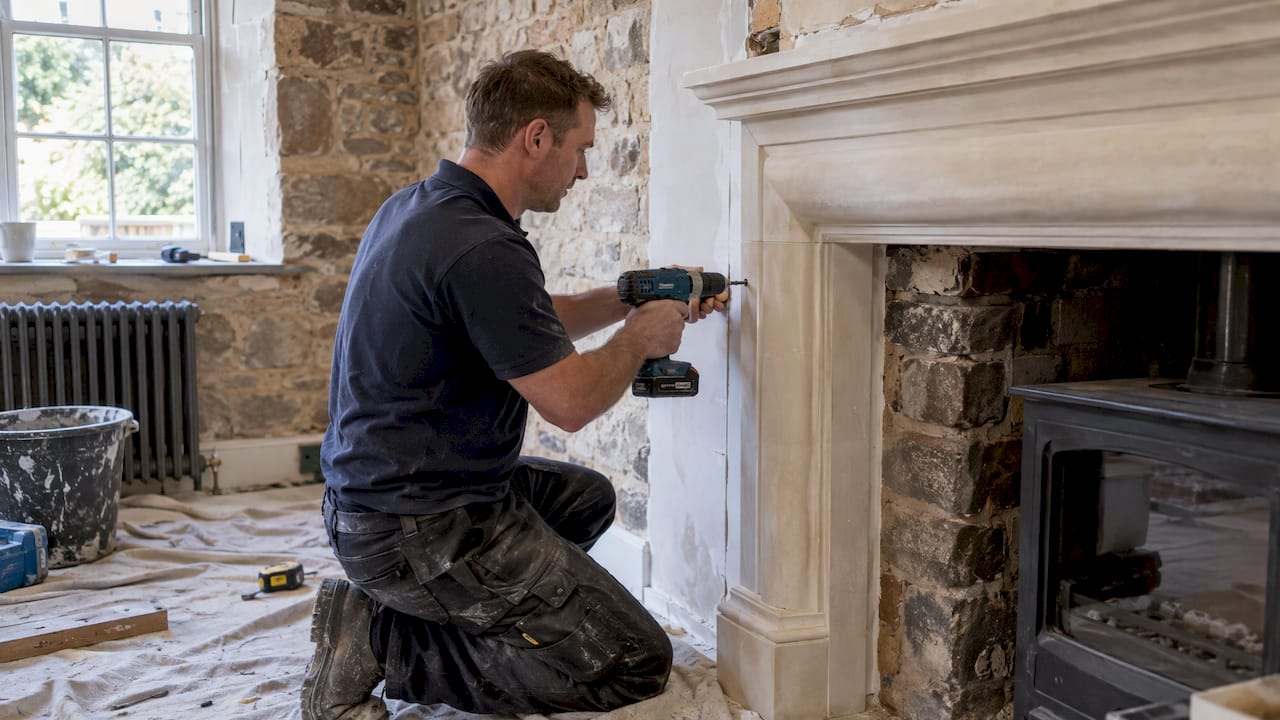
This applies to the surround itself. Lightweight decorative mouldings, such as a polyurethane trim or panel moulding on the wall around it, are decorative finishes and are glued and pinned in the usual way.
How to fit decorative fireplace mouldings
- Check the appliance instructions. Mark the clearance zone on the wall in pencil before you plan any trim.
- Measure the opening and wall. Measure width at the top, middle and bottom, and check diagonals for squareness. Old chimney breasts are rarely true.
- Dry-fit everything. Offer up each piece and check face planes with a long spirit level and straightedge. Number the back of each length so it goes back in the same place.
- Cut the mitres. Cut external and internal corners in a mitre box or with a mitre saw, and test each joint dry.
- Fix. Apply a suitable moulding adhesive and pin where the profile allows. Our adhesives and accessories are matched to polyurethane.
- Fill and finish. Fill joints and pin holes with flexible filler, let it cure, then paint. A flexible filler copes better with the heating and cooling cycles near a fire than hard cement, a point also made in restoration guidance.
Carl’s Installer Tip
In our experience, the most common mistake is fitting the trim first and checking the clearances afterwards. We’ve found it saves a lot of rework to dry-fit the whole scheme, pencil the clearance line, and only then cut. Mitres on a chimney breast rarely meet at a perfect 90 degrees, so scribe the cut to the wall and finish with flexible filler rather than forcing a joint.
What do fireplace mouldings cost
Prices vary with the profile size, the material and whether you are dressing a shelf, a whole surround or a full chimney breast. Polyurethane lengths are generally sold per length, so measure the total run and add an allowance for mitres and waste. Browse the cornice and coving and skirting categories for current prices, and see our decorative mouldings buying guide for how to plan quantities.
Our view
We think the best fireplace schemes are the quiet ones. A well-chosen profile, correctly scaled and painted in a colour that ties to the room, does more than a heavy surround ever will.
Our experience is that polyurethane gives homeowners, decorators and designers the most dependable route. The detail is crisp, the lengths are light to handle and the finish takes paint well. That is why we stock the full Orac Decor and NOËL & MARQUET range, from traditional cornice to modern square profiles and LED lighting profiles for a soft glow above the mantel.
We also know that a good result depends on the fitting. Through our Elite Decor UK national installer network we can arrange professional installation, so the project can run from choosing the profile to the finished room.
Carl
Start your fireplace project
Our range covers every part of a fireplace scheme: cornice and coving, wall panelling, LED coving for a lit finish and adhesives for fixing. If you would rather have it done for you, we can arrange professional installation across the UK.

Choose your profiles, measure carefully and order from Coving.Online.
FAQ
Can I put mouldings around a wood burner or open fire?
Yes, as long as they sit outside the clearance zone the appliance manufacturer specifies. Distances to combustible materials differ by appliance, so read the instructions first. Keep decorative trim to the wall and shelf area away from the opening.
Is polyurethane a good choice for fireplace mouldings?
Yes for decorative trim. It reproduces fine detail, is light, easy to cut and fit, and resists warping or cracking. It suits traditional and modern profiles alike once painted.
Can I fit a fireplace surround myself?
Lightweight decorative mouldings are a sensible DIY job. For a surround, standards call for competent installers working to the manufacturer’s specification with mechanical fixings, so we recommend our installer network for those.
Which profile suits a period home?
Crown, dentil and egg-and-dart profiles suit Georgian and Victorian rooms. Match the scale to the chimney breast and the existing cornice and skirting.
Sources
- This Old House: mantel moulding profiles
- Architecture Adrenaline: choosing fireplace moulding trim
- Tipsfireplace: moulding ideas
- Tipsfireplace: decorative fireplace mouldings
- HETAS guidance: secure your surround
- Gas fire installer and owner guide
- NHBC Standards 2026: fireplaces, chimneys and flues
- Fran Murphy Interiors: surround rebuild guide
Recommended
- Architectural Moulding Styles for Every Room
- Decorative Mouldings for Walls Made Practical
- Decorative Mouldings Buying Guide for UK Homes
- Picture Frame Moulding on Walls: Designs, Layout and Fitting
