

Home Decor
Can polyurethane coving be fire rated? Here’s the honest answer
Aug
Yes, but only conditionally: polyurethane coving can achieve a recognised reaction-to-fire classification, though only for specific products, installed exactly as the manufacturer’s system dictates. The rating lives with the product datasheet, not with polyurethane as a material category.
The standard to check is EN 13501-1, the European classification system for reaction-to-fire performance. Orac, for example, states that parts of its polyurethane ranges can reach Bs2d0 or Cs2d0 classifications when fitted with a specified adhesive, sealer, and within defined coverage limits. Step outside those conditions and the classification no longer applies.
Before you order anything, check three things:
- The exact EN 13501-1 class stated on the technical datasheet, not on marketing copy
- Which adhesive and sealer the classification depends on
- Any maximum coverage percentage the manufacturer sets for that rating to hold
Key Takeaways
A polyurethane coving’s fire rating only holds when the exact certified adhesive, coverage limit, and installation method stated on its datasheet are followed on site.
| Point | Details |
|---|---|
| Check the classification, not the marketing | Look for a stated EN 13501-1 class (such as Bs2d0) on the technical datasheet, not on general product copy. |
| Understand the letters | The main class covers flame spread, ‘s’ covers smoke, and ‘d0’ means no flaming droplets. |
| Ratings are system-specific | The classification applies only with the named adhesive, sealer, and coverage limit, changing any of these can void it. |
| Reserve non-combustible materials for higher-risk areas | Use plaster or non-combustible options for escape routes, corridors, and communal staircases. |
| Buy from a supplier who provides the paperwork | Coving.Online supplies Orac Decor and NOËL & MARQUET profiles with technical documentation and access to certified Elite Decor UK installers. |
Table of Contents
- What EN 13501-1 reaction-to-fire classifications mean for mouldings
- The lab tests behind every fire claim on a datasheet
- Why installation and formulation decide whether the rating actually holds
- How to verify a manufacturer’s fire claim before you buy
- When polyurethane coving works and when to specify something else
- What this compliance question actually comes down to
- Get fire-rated coving fitted the right way, with the paperwork to prove it
- Frequently asked questions
- Sources
What EN 13501-1 reaction-to-fire classifications mean for mouldings
EN 13501-1 grades how a material behaves when exposed to fire, from A1 (non-combustible, think stone or concrete) down to F (no tested performance at all). Most polyurethane coving that carries a rating sits in class B, C, or D, alongside two extra letters that matter just as much as the main grade; for more on choosing the right material, see What Kind Of Doors Are Best For Interiors?
The ‘s’ figure covers smoke production (s1 being the least smoke, s3 the most), and the ‘d’ figure covers flaming droplets or particles falling from the material as it burns (d0 means none). A classification of Bs2d0 tells you the product is a “B” for flame spread, produces a moderate amount of smoke, and drops no flaming debris. Cs2d0 is one step below B on flame performance but keeps the same smoke and droplet behaviour.
- B — limited combustibility, restricted flame spread under test conditions
- C — combustible but with contained fire growth
- s2 — moderate smoke opacity during the test
- d0 — no flaming droplets or particles produced
It’s worth being clear on one distinction that trips up a lot of buyers: reaction-to-fire classification measures how a material contributes to a fire once it starts. It says nothing about the structural fire resistance of a wall or ceiling, which is a separate rating (expressed in minutes, like 30 or 60) covering how long a construction holds back fire and heat. Coving sits on top of that structure; it doesn’t change the structure’s own rating.
The lab tests behind every fire claim on a datasheet
Manufacturers back their EN 13501-1 claims with laboratory data, and knowing the names behind the numbers helps you judge how solid a claim actually is. The cone calorimeter test measures peak heat release rate (pHRR) and total heat release (THR): how fast a burning sample gives off heat, and how much energy it releases overall. Lower figures on both mean a slower-growing, less intense fire.
Two older but still common polymer tests show up on some technical sheets:
- LOI (Limiting Oxygen Index) measures the minimum oxygen concentration needed to sustain combustion, a higher LOI means the material self-extinguishes more readily
- UL-94 rates how a small vertical or horizontal sample behaves when a flame is applied and removed, with V-0 being the best commonly cited outcome
Neither test alone proves a product’s real-world fire performance. Cone calorimeter and UL-94 results come from small samples under controlled lab conditions, and full-scale or medium-scale testing (the kind that feeds a proper EN 13501-1 classification report) often reveals that flashover risk remains unless the whole system is controlled, not just the raw material. A single LOI figure on a spec sheet is a data point, not a certificate.
Why installation and formulation decide whether the rating actually holds
A declared fire class is a laboratory result tied to one exact configuration. Change any part of that configuration on site, and you’re no longer covered by the certificate.
- Material formulation — flame-retardant additives, intumescent coatings, and nanocomposite fillers can markedly improve a polyurethane’s fire parameters, including LOI, UL-94 rating, and heat release rate, but only in the formulation actually tested.
- Coverage percentage — some ranges only hold their classification up to a stated proportion of wall or ceiling area; Orac notes that certain profiles achieve Bs2d0 only up to a defined coverage limit when installed with the specified adhesive.
- Adhesive and primer — the certified system often names a particular adhesive or sealer as part of the classification. Swap it for a cheaper alternative and the rating no longer applies.
- Substrate interaction — plasterboard, plaster, and any insulation behind the coving all influence how the whole assembly behaves in a fire, not just the moulding itself.
- Smoke toxicity — flame-retardant additives that cut heat release can raise the toxicity of the smoke produced, so a lower flame-spread figure isn’t automatically the safer overall outcome.
Pro Tip: In our experience, the single most common way installers accidentally void a fire classification is using whatever adhesive is already on the van rather than the one named on the datasheet. If the certificate specifies a particular adhesive or sealer, that’s not a recommendation, it’s a condition of the rating.
How to verify a manufacturer’s fire claim before you buy
A confident sales page is not the same as a classification report. Work through this before placing an order:
- Find the technical datasheet and the specific EN 13501-1 statement on the manufacturer’s own site or Declaration of Performance (DoP), not a reseller’s description
- Ask for the full classification report or the underlying cone calorimeter data if the datasheet only quotes a headline class
- Confirm which adhesive, sealant, or surface treatment the classification is conditional on, and price that in
- Check whether the stated classification still applies at your intended coverage and for your room type
- Keep every datasheet and installation instruction on file. Building control or a handover pack will often ask for exactly this paperwork
When polyurethane coving works and when to specify something else
Polyurethane coving with a genuine Bs2d0 or Cs2d0 classification is a reasonable, well-evidenced choice for most domestic rooms, living spaces, bedrooms, and hallways where coverage stays modest and the certified adhesive is used properly. Where the stakes are higher, the safer default shifts.
- Escape routes, communal corridors, and staircases in multi-occupancy buildings call for the most conservative specification available, and that often means plaster coving or another non-combustible option rather than a polymer product, regardless of its rating.
- High-coverage decorative schemes (extensive coving runs, large ceiling roses, or wall panelling covering a big proportion of a room) push closer to the coverage limits manufacturers set for their classification, so check the percentage before committing to the design.
- Private rooms with standard coving runs sit well within the tested conditions for most rated polyurethane ranges, making them a sensible fit for the material.
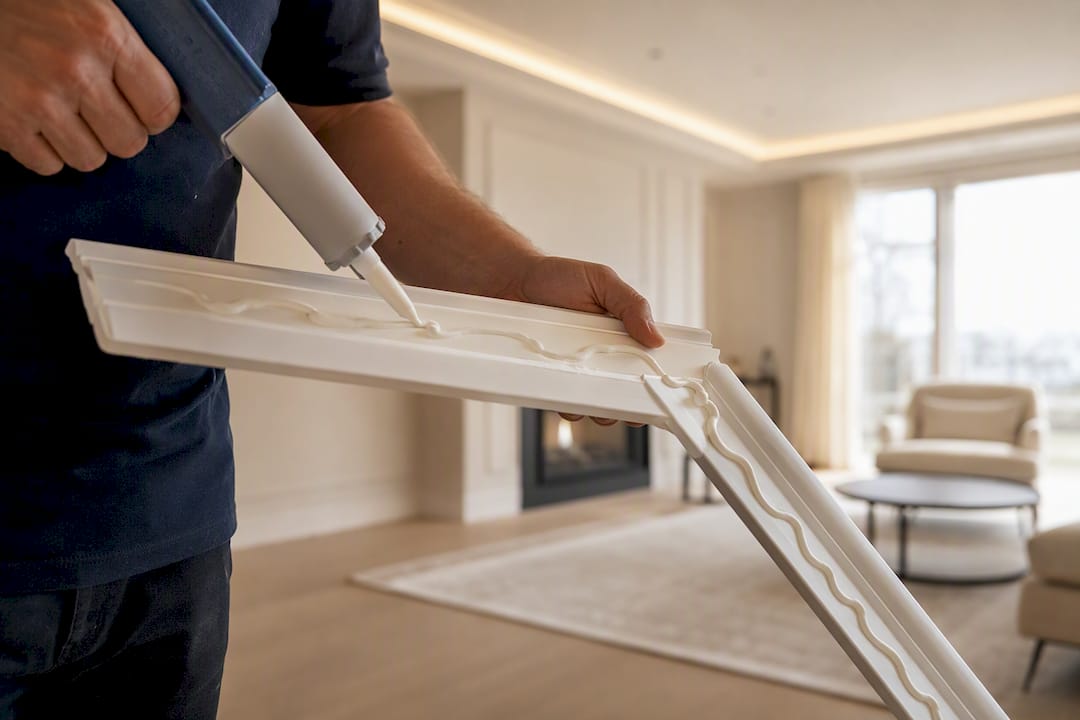
Whichever route you take, an installer checklist keeps the declared performance intact: stick to the manufacturer’s coverage limit, use only the specified adhesive and sealer, never box in or cover ventilation with the moulding, and document the exact system used for the project file.
Carl’s installer tip: getting the paperwork right on site
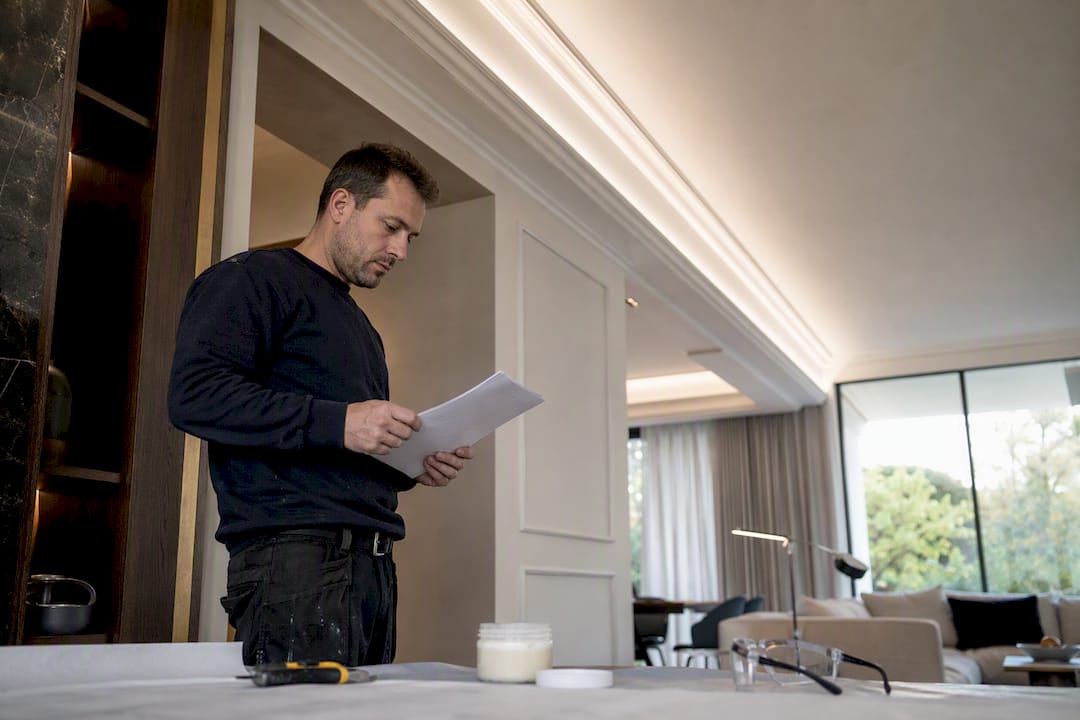
Pro Tip: Always request the classification documents at the point of purchase, not after the coving is up. Coving.Online supplies Orac Decor and NOËL & MARQUET profiles with the correct technical paperwork, and can arrange fitting through the Elite Decor UK installer network so the certified system, adhesive included, actually gets used.
What this compliance question actually comes down to
Most guidance on this topic treats “fire rated” as a single yes or no answer, and that’s the part I’d push back on hardest. The evidence, from Orac’s own conditional classifications to the full-scale testing research, points to something less tidy: a rating is a description of one tested system, not a property of polyurethane as a material.
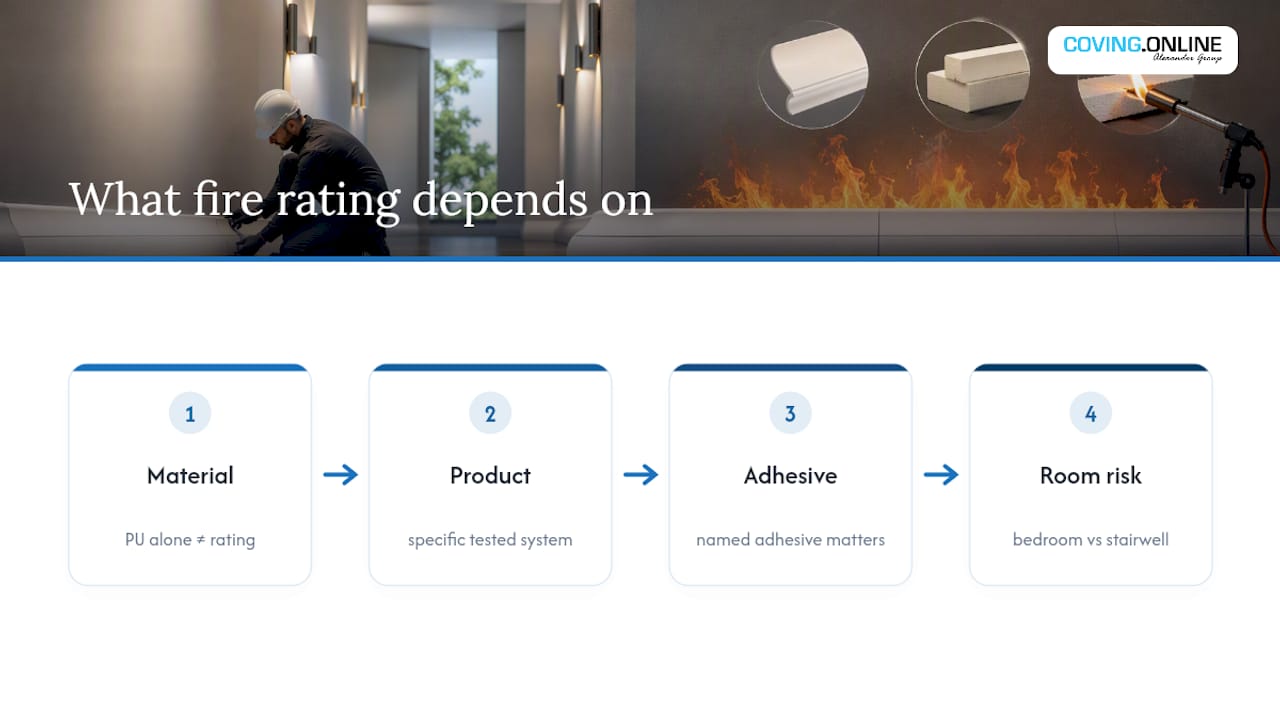
That means the conventional advice, “check if it’s fire rated”, asks the wrong question. The better question is whether the specific product, adhesive, coverage, and room type in front of you matches what was actually tested. A homeowner fitting modest coving runs in a bedroom is in a very different risk position to a landlord covering a shared stairwell, even with identical coving.
If you take one thing from this, prioritise the paperwork over the headline claim. A supplier who can hand you the classification report and the named adhesive system is worth more than one who just quotes “Class B” on a product page. That distinction is where real compliance sits, not in the letter grade alone.
Get fire-rated coving fitted the right way, with the paperwork to prove it
Coving.Online is the specialist route to genuinely compliant decorative mouldings, not just a supplier of profiles that look the part. Every Orac Decor and NOËL & MARQUET product we stock comes with proper technical documentation, so you’re never left guessing which adhesive or coverage limit a classification actually depends on.
That matters more than it sounds. A generic merchant listing rarely tells you which sealer a Bs2d0 rating requires, but our product range is set up so the datasheet and the classification travel together with every order. If you’d rather not manage the installation yourself, our Elite Decor UK network fits coving using the exact certified system, adhesive and coverage limits included, so the rating on the box still applies once the job’s finished. Browse the Orac C358 coving range or get in touch through Coving to request classification documents before you order.
Frequently asked questions
Is polyurethane fire resistant on its own, without any additives?
No. Untreated polyurethane is combustible, and any fire class you see on a datasheet reflects a specific formulation with flame retardants or coatings, tested as a complete system rather than the raw material alone.
What does a fire rated coving certificate actually cover?
It covers the exact product, adhesive, sealer, and coverage limit tested together. It does not automatically extend to the same coving fitted with a different adhesive or over a larger area than specified.
Do all Orac Decor or NOËL & MARQUET profiles carry the same fire classification?
No, classifications vary by range and profile. Always check the specific product’s own technical datasheet rather than assuming a rating applies across an entire collection.
Is plaster coving always safer than polyurethane coving for fire performance?
Plaster is non-combustible by nature, which makes it a conservative default for escape routes and communal areas. For most private rooms, a properly installed and certified polyurethane product performs within acceptable limits.
Where do I find a product’s official fire classification statement?
Look for the Declaration of Performance (DoP) or technical datasheet on the manufacturer’s own site. A reseller’s product description is not a substitute for the manufacturer’s own classification documentation.
Sources
- Product information | Orac
- Fire propagation characteristics and fire risks of polyurethanes: effects of material type (foam & board) and added flame retardant
Recommended
