

Home Decor
Polyurethane Moulding Benefits: Why Fitters Choose It

Oct
Polyurethane moulding is light, moisture resistant, stable, quick to cut and fix, and it holds fine detail well. For most UK homes that makes it the most practical way to add coving, cornice, ceiling roses, skirting or panelling. It isn’t right for every job, though. Period restoration, strict fire requirements and some finishing details need more thought, and we cover those below.
We supply and arrange installation of Orac Decor and NOËL & MARQUET polyurethane profiles, so this comes from what we see on real jobs as well as in the catalogue.
TL;DR
- Polyurethane is far lighter than plaster, so it is easier to lift, cut and fix, often by one person.
- It is a closed-cell material, so it does not swell or warp like MDF or softwood. That suits kitchens, bathrooms and exterior-rated profiles.
- Fine detail, long lengths and fewer joints give a crisper, more consistent finish than many buyers expect.
- Fire performance belongs to the whole system, not just the material, so check the classification for your project.
- Plaster still has a place in heritage restoration. For most modern projects polyurethane is the practical choice.
Table of Contents
- What polyurethane moulding actually is
- Benefit 1: It is light, so fitting is easier and safer
- Benefit 2: Moisture resistance
- Benefit 3: Stability, and fewer callbacks
- Benefit 4: Crisp detail and consistent quality
- Benefit 5: Quick to cut, fix and finish
- Benefit 6: Versatility across the whole room
- Does it add value to a home?
- Where polyurethane is not the best answer
- Our perspective
- Choosing and buying polyurethane moulding
- Ready to start your project?
- FAQ
- Sources
What polyurethane moulding actually is
Polyurethane (PU) moulding is a rigid polymer, cast or formed into decorative profiles. The range covers coving and cornice, ceiling roses, skirting boards, door surrounds, wall panelling, 3D wall panels and profiles that conceal LED lighting. It is supplied ready to fix, usually with a primed surface ready for paint.
If you want the background first, our guide to what polyurethane coving is covers the basics. Here we focus on what the material does for you in practice.
Benefit 1: It is light, so fitting is easier and safer
The benefit you notice first is weight. A length of polyurethane cornice is a fraction of the weight of the same profile in plaster. That changes the job in three ways:
- Overhead work is less tiring. Holding a length against a ceiling while the adhesive grabs is a very different task with a light profile.
- Fewer people are needed. Many rooms can be done by one competent person, where long plaster runs usually need two.
- Less load on the wall and ceiling. That matters on older ceilings, lath and plaster, or plasterboard of uncertain condition.
We go into this further in our piece on lightweight cornice moulding.
Benefit 2: Moisture resistance
PU is a closed-cell polymer. Unlike MDF or softwood, it does not absorb water, so it will not swell, split or encourage mildew in the way timber-based products can. That makes it a sensible choice for:
- bathrooms and shower rooms, away from direct water jets;
- kitchens, where steam and temperature swings are constant;
- utility rooms and porches;
- exterior-rated profiles around doors, windows and façades.
Our article on whether polyurethane mouldings are moisture resistant explains where the limits are. The material resists moisture. The adhesive, the sealant and the decorating still need to be right.
Benefit 3: Stability, and fewer callbacks
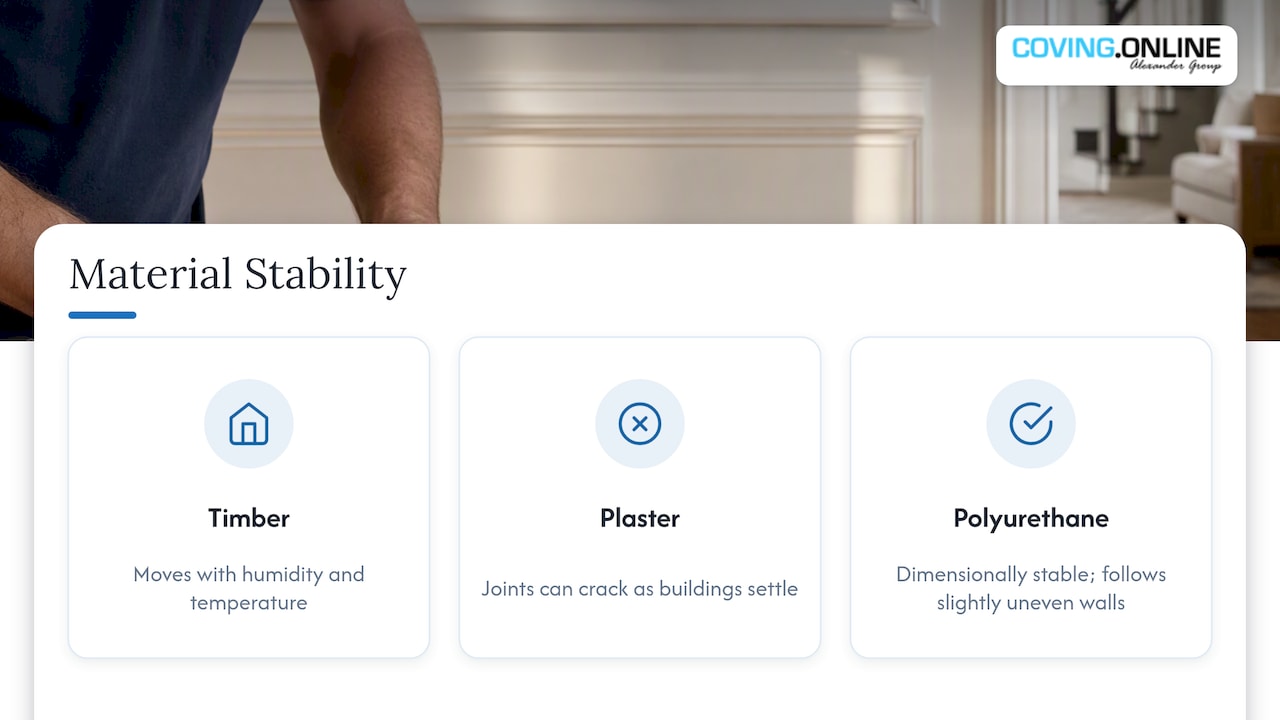
Timber moves with humidity and temperature. Plaster can crack at joints as a building settles. Polyurethane stays dimensionally stable, so joints stay tighter and paint lines stay cleaner over time. Because it is flexible within limits, a length will follow a slightly uneven wall better than a rigid profile. It is not a cure for badly out-of-true walls, but it forgives more.
If you are weighing it against wood, see our comparison of polyurethane versus timber for mouldings.
Benefit 4: Crisp detail and consistent quality
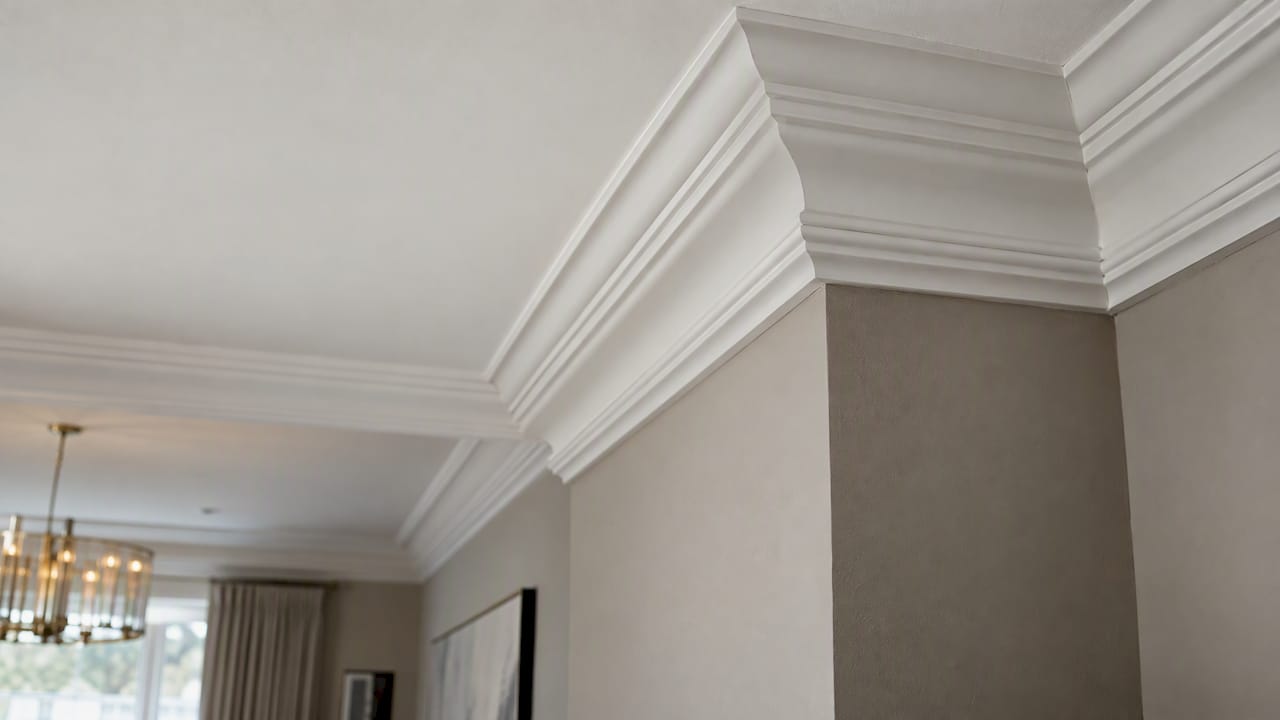
Polyurethane is made in moulds, so every length of a profile is the same. That gives sharp edges, deep relief and repeatable detail, from a simple Victorian-style cornice to a contemporary square-edged profile. It is also available in long lengths, which means fewer joints to fill and sand.
The design range is wide. Our guides on design options and styles and architectural moulding styles for every room are a good place to start choosing.
Benefit 5: Quick to cut, fix and finish
Polyurethane cuts with a fine-toothed saw and a mitre box. It is fixed with adhesive, so there are no plaster mixes to prepare and much less mess and dust than a plaster job. Most profiles arrive primed, so decorating is usually a matter of filling the joints and applying paint.
That is why DIYers and trade decorators both like it. A typical room takes a fraction of the time it would in traditional plaster, and the clean-up is minimal.
Carl’s Installer Tip
In our experience, most poor results come from preparation, not the material. We’ve found three habits that make the biggest difference:
- Dry-fit every length first. Hold each piece up and check the mitres before any adhesive goes on.
- Fix to a clean, dust-free surface. Remove loose paint and wipe down. Adhesive bonds to the surface, not to the dust on it.
- Cut internal corners as a scribe or a mitre, and test on offcuts. Walls are rarely 90 degrees, so a spare piece will save you a full length.
Also, do not leave unpainted polyurethane exposed to strong sunlight for long. Our trade advice on priming polyurethane mouldings and the UV risk explains why, and what to do about it. More on technique is in our installation tips for polyurethane coving.
Benefit 6: Versatility across the whole room
Polyurethane is not only for coving. The same material covers a whole scheme, so everything matches in finish and style:
| Product | Best for |
|---|---|
| Cornice and coving | Softening the wall and ceiling joint, from classic to contemporary |
| Ceiling roses | A focal point around a pendant light |
| Skirting | Taller, more substantial skirting that anchors the space |
| Panelling | Dado-height or full-height wall treatments that introduce rhythm |
| 3D wall panels | A modern feature wall with texture and shadow |
| LED coving | Indirect lighting hidden within the profile |
If you are planning a feature wall, our guides to decorative mouldings for walls and what wall panelling is show how the pieces work together. For lighting, see LED lighting in coving.
Does it add value to a home?
Be realistic here. Estate agents quoted by one US property resource say the value of crown moulding is mostly aesthetic and emotional rather than a pound-for-pound return. It signals care and a more finished build, and it can make a property feel more polished to buyers. It is not a reason to add it purely to lift a sale price.
The appeal to buyers is well recognised in other interior features too. For example, an Australian shutter supplier discusses how interior features can influence sale appeal in its own market. Treat such figures as local to that country, but the principle carries over: good detailing makes rooms feel finished.
So choose polyurethane because it gives you a good result at a sensible cost and effort, and because you will enjoy the room.
Where polyurethane is not the best answer
We would rather you chose well than chose us for the wrong job.
- Heritage restoration. In a listed or carefully conserved Victorian or Edwardian house, original plaster mouldings are often better repaired than replaced. Our comparisons of polyurethane cornice versus plaster and coving versus plaster, and which fits set out when each wins.
- Strict fire requirements. Fire performance is a property of the whole system, including fixings and the substrate, not just the material. Some polyurethane mouldings can reach EN 13501-1 classes, but this depends on the installation method and how much of the wall is covered. Check the requirements in Approved Document B and confirm the product’s classification with us before you order for flats, communal areas or commercial buildings. Our article on whether polyurethane coving can be fire rated gives the honest answer.
- Scale mistakes. Proportion matters more than size. Architects advise that a simple, correct profile often looks better than an oversized, elaborate one, and that miscalculating scale can make a room feel smaller or unbalanced. Pick the profile height to suit the ceiling height, not the catalogue photograph.
- Heavy knocks. Some fitters note that polyurethane can dent more easily than hard plaster, so use your judgement near doorways and for skirting in high-traffic hallways.
Our perspective
We supply the full Orac Decor and NOËL & MARQUET ranges and can arrange fitting through our Elite Decor UK installer network. Seeing the product go on the wall as well as out of the box shapes our view.
We think polyurethane has won its place because it solves real problems: weight, mess, moisture, and joints that open up. It does not replace plaster everywhere, and we would never claim it does. In a modern build or a standard renovation, it is usually the better route. In a conserved period room, repair first.
The best results come from the same few things: the right scale, careful preparation, proper priming and a patient mitre. A premium profile fitted badly looks worse than a modest one fitted well. If you are unsure, ask us before you order.
— Carl
Choosing and buying polyurethane moulding
A few decisions will save you money and rework:
- Start with ceiling height and room size. This sets the profile depth. Taller ceilings can carry larger, built-up cornices.
- Pick the style to match the house. Keep detail simple in a plain modern room, richer in a period-style one.
- Order everything together. Matching adhesive, sealant, corners and accessories from one place avoids mismatches.
- Allow for wastage. Mitres use more length than the wall measurement suggests.
- Decide whether to fit it yourself. It is DIY-friendly, but for long runs, stairwells or high ceilings, a professional is quicker.
Our decorative mouldings buying guide for UK homes walks through each step in more detail.
Ready to start your project?
Browse our full range of cornice and coving, plus skirting, panelling and adhesives and door surrounds. If you would rather have it done for you, we can arrange professional fitting through our national installer network: find out about installation. Tell us about your room and we will help you choose the right profile.
FAQ
Is polyurethane moulding waterproof?
Polyurethane is a closed-cell material, so it does not absorb water or swell like MDF or softwood. That makes it suitable for bathrooms and kitchens. The adhesive, sealant and paint should still be suitable for damp rooms, and it should not sit in constant direct water.
Is polyurethane moulding as good as plaster?
For most modern homes, yes, and it is easier to fit. It is lighter, cleaner and more stable. Plaster remains the better choice for restoring original period features, where matching the existing material matters.
Is polyurethane moulding fire resistant?
Some polyurethane mouldings can meet EN 13501-1 classes, but the result depends on the whole system, including fixings and wall coverage. For flats, communal areas and commercial projects, check the product classification and Approved Document B requirements before buying.
Can I fit polyurethane moulding myself?
Yes. It cuts with a fine saw and mitre box and is fixed with adhesive. Dry-fit every length, prepare the surface, and consider a professional for long runs or high ceilings.
Sources
Recommended
- Polyurethane Versus Timber for Mouldings
- Are Polyurethane Mouldings Moisture Resistant?
- Polyurethane Cornice vs Plaster – Which Is Best?
- Polyurethane Coving in the UK | Transform Your Home
