

blog
How to Fit Coving Around a Bay Window

Jun
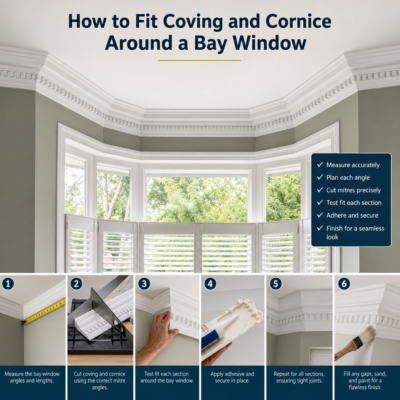
How to Fit Coving Around a Bay Window
Adding coving or cornice around a bay window can transform a room, softening the transition between wall and ceiling while giving the space a more polished, traditional finish. A bay window can look beautiful on its own, but when the moulding follows the curve or angled shape correctly, it becomes a real feature rather than an awkward obstacle.
If you are planning a home decor update, fitting coving around a bay window is one of the most rewarding finishing jobs you can do. It does require careful measuring, cutting, and patience, but the results are well worth the effort.
Why Bay Windows Need Special Attention
A standard straight wall is simple to measure and cut for coving. A bay window is different because it usually includes angled sections or a curved face, which means the moulding must follow multiple changes in direction.
That is why many DIYers find a bay window more challenging than a regular room. The good news is that with the right approach, the process is manageable whether you are using traditional plaster profiles or lightweight modern options such as orac decor products.
Choose the Right Coving or Cornice
Before starting, decide on the style and material of your moulding. Larger rooms often suit a deeper cornice, while simpler rooms may look better with a slimmer coving profile.
Common material options
- Plaster coving: Traditional, heavy, and ideal for period homes
- Polyurethane or lightweight mouldings: Easier to handle and cut
- Expanded polystyrene: Budget-friendly and simple to install
- Decorative systems like orac decor: Lightweight, durable, and popular for modern home decor projects
When fitting around a bay window, lightweight products are often easier because they are simpler to cut and hold in place while the adhesive sets.
Measure the Bay Carefully
Accurate measurement is the key to a neat finish. Start by measuring each section of the bay separately. Most bays are made up of three or more faces, so do not assume the lengths are identical.
What to measure
- The length of each wall section
- The angle of each corner
- The height from ceiling to top of window frame
- The total run of coving needed, including waste
It helps to make a sketch of the bay and label each section. This will make cutting and installation much easier later.
Mark Out the Position
Use a pencil and a spirit level to mark where the top edge of the coving will sit around the room. Continue the line carefully across the bay window area so the moulding remains consistent.
If your bay window has a curved shape, use smaller reference marks or a flexible guide to follow the arc as smoothly as possible. A neat line at this stage prevents problems later, especially when joining multiple pieces of coving or cornice.
Cutting Coving for Bay Window Angles
This is the part that usually causes the most concern. Corners in a bay window are often not 90 degrees, so standard cuts may not fit properly.
Helpful cutting tips
- Use a proper coving mitre box or saw guide
- Identify whether the angle is internal or external
- Test each piece before applying adhesive
- Label each cut section to avoid confusion
For angled bays, you may need to trim pieces at slightly different angles to make the joints meet cleanly. Take your time and dry-fit everything first. It is much easier to adjust a cut on the bench than on the ceiling.
If you are using a lightweight system such as orac decor, follow the manufacturer’s cutting guidance closely. These profiles are often designed to make complex shapes easier to handle, especially in home decor projects where a sharp, clean finish matters.
Dry Fit Before You Fix
Always test-fit the coving before sticking it in place. Hold the lengths up to the ceiling and check how the joints meet at each corner.
This step lets you see:
- Whether the angles are correct
- If any section needs trimming
- How the profile sits against uneven walls or ceilings
Bay windows often reveal small imperfections in the room, so expect to make minor adjustments. A little sanding or recutting can make a big difference to the final appearance.
Fix the Coving in Place
Once you are happy with the fit, apply adhesive to the back edges of the coving or cornice. Press each section into place carefully, starting with one end and working your way along the bay.
Best practice for installation
- Use enough adhesive to create a strong bond
- Hold each piece steady for a moment
- Wipe away excess adhesive immediately
- Use temporary supports if needed
For heavier plaster mouldings, mechanical fixings may also be required. Lightweight coving usually stays in place with adhesive alone.
Fill, Sand, and Finish
Even a well-cut bay window installation will usually need a bit of finishing. Fill small gaps at joints and corners with decorator’s caulk or filler. Once dry, sand lightly for a smooth result.
Then prime and paint the coving or cornice to match the room. A clean white finish is classic, but coloured moulding can also work well in modern home decor schemes.
Final Thoughts
Fitting coving around a bay window takes planning, but it can completely change the look of a room. The key is to measure carefully, cut accurately, and work patiently through each section of the bay.
Whether you choose traditional cornice or a lightweight option like orac decor, the right moulding adds character, depth, and elegance. For anyone updating their home decor, this is one detail that delivers a big visual impact.
