

Home Decor
Moulding Terminology: A Plain Guide to Coving, Cornice and More

Nov
Moulding is a shaped strip fixed to a wall or ceiling to decorate it or to hide the join between two surfaces. Most of the confusion comes from the names: coving, cornice, architrave and skirting are used loosely, and UK and US terms differ. This guide sets out what each word means, how profiles are measured and how to choose. We supply Orac Decor and NOËL & MARQUET polyurethane mouldings, so the examples lean on what we fit and sell every day.
TL;DR
- Decorative moulding covers joins and adds shape: coving and cornice at the ceiling, skirting at the floor, architrave round doors, dado rail at waist height.
- “Coving” strictly means a plain, concave profile; “cornice” is the wider term for any ceiling-edge moulding. In everyday UK talk the two overlap.
- Coving size is measured diagonally across the face, not by height or projection.
- Today most profiles are polyurethane rather than plaster, which makes them lighter and easier to fit.
- Match the profile to the age and proportions of the room, not to a trend.
Table of Contents
- What “moulding” means
- The main types and where they go
- UK terms explained
- How moulding is measured
- Matching profile to period and style
- Materials: why the word has changed
- Carl’s Installer Tip
- Ready to choose
- FAQ
- Sources
What “moulding” means
In British English the word is spelt with a “u”; “molding” is the American spelling. Both refer to the same thing, and Wikipedia’s entry on decorative moulding notes that in British English it is sometimes called coving.
There are two meanings worth separating:
- Decorative moulding: a strip with a shaped profile fixed to a surface for decoration, particularly to cover joins such as the one between ceiling and wall.
- Manufacturing moulding: shaping a material in a mould. BBC Bitesize describes injection moulding, where melted plastic is pushed into a mould, and extrusion, where it is pushed continuously through a die. Extrusion can produce trim profiles in volume.
The word is now slightly misleading for interiors. As DIY Doctor points out, features are no longer moulded in plaster on site and are more often made from hardened polyurethane.
The main types and where they go
Working from the ceiling down, DIY Doctor’s guide to architectural mouldings gives the standard set:
| Term | Where it sits | What it does |
|---|---|---|
| Coving / cornice | Where wall meets ceiling | Hides the join, softens the corner |
| Picture rail | Around 300 to 500 mm below the ceiling | Gives a place to hang pictures |
| Dado rail | Roughly 900 to 1500 mm up the wall | Divides the wall, traditionally protects it |
| Panel moulding (wainscot) | On the wall surface | Frames panels for a traditional or modern look |
| Skirting | Where wall meets floor | Protects the base of the wall |
| Architrave | Around door and window frames | Frames the opening |
| Ceiling rose | Around a central light fitting | Focal point on the ceiling |
| Corbel | Under a shelf, beam or mantel | Decorative bracket |
UK terms explained
Cornice is the moulding at the junction of ceiling and wall, as the ABSP architecture dictionary puts it. It can be plain or richly ornamented.
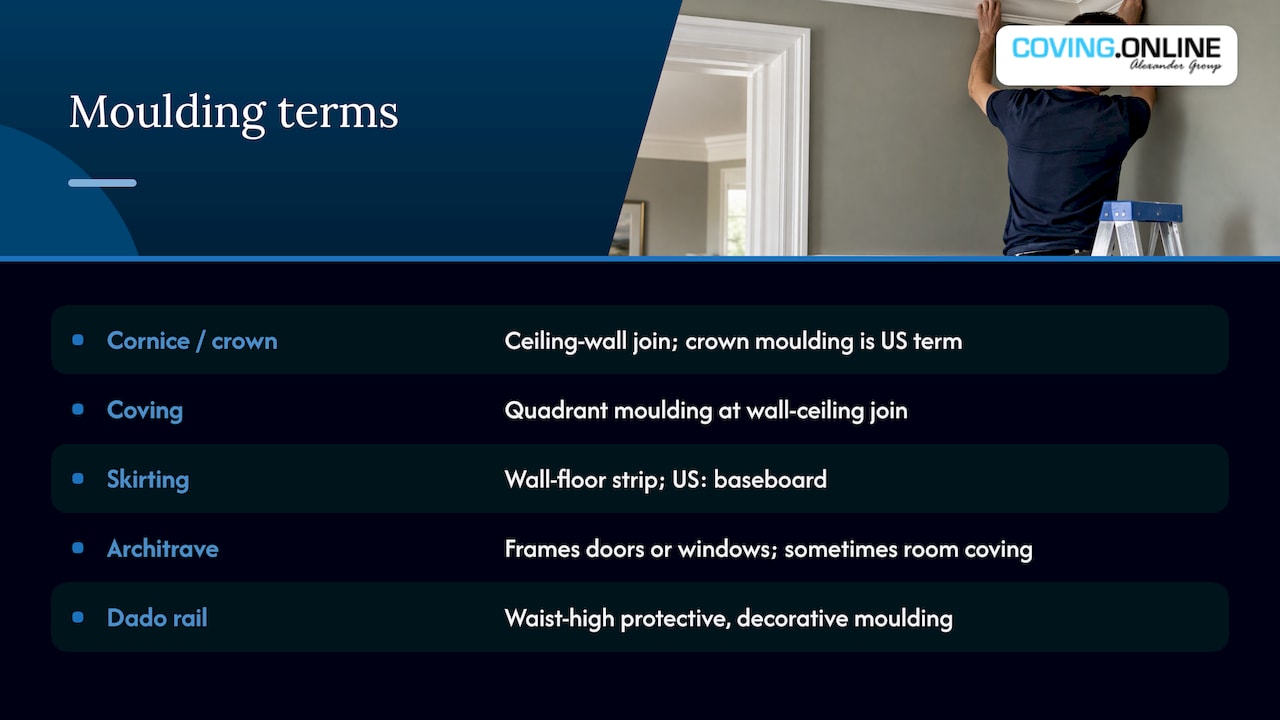
Coving is, in the same dictionary, a quadrant moulding covering the wall and ceiling join. The word stuck because the plain, C-shaped profile became so popular in the early twentieth century that people began using it for all plainer cornices. Our article on the difference between coving and cornice goes further.
Skirting is, according to the Dulux decorating glossary, the strip joining walls and floors. Americans say baseboard.
Architrave frames a door or window. The same glossary notes that the word is sometimes used for coving around the top of a room, which is why you may meet it in older descriptions.
Dado rail is the waist-high protective and decorative moulding. Crown moulding is the American term for cornice.
Plain and sprung
A plain moulding has right-angled edges and is fixed flat to a surface. A sprung moulding has bevelled rear edges so it can sit between two surfaces that are not parallel, such as a wall and a ceiling. Coving and cornice are sprung mouldings.
How moulding is measured
Size is where buyers most often go wrong. DIY Doctor lists four measurements for a cornice:
- Size: the straight line across the front of the profile.
- Projection: how far it sticks out along the ceiling.
- Drop (or height): how far it falls down the wall.
- Length of each section.
Coving size is the imaginary diagonal line across the face, the longest side of the triangle formed by wall and ceiling. The most common sizes are 125 mm and 85 mm, and when cutting you measure along the edge that sits against the wall.
Check the projection and drop as well as the headline size, because two profiles of the same size can look very different on the wall. Our coving size guide shows how to measure a room and work out how much to order.
Matching profile to period and style
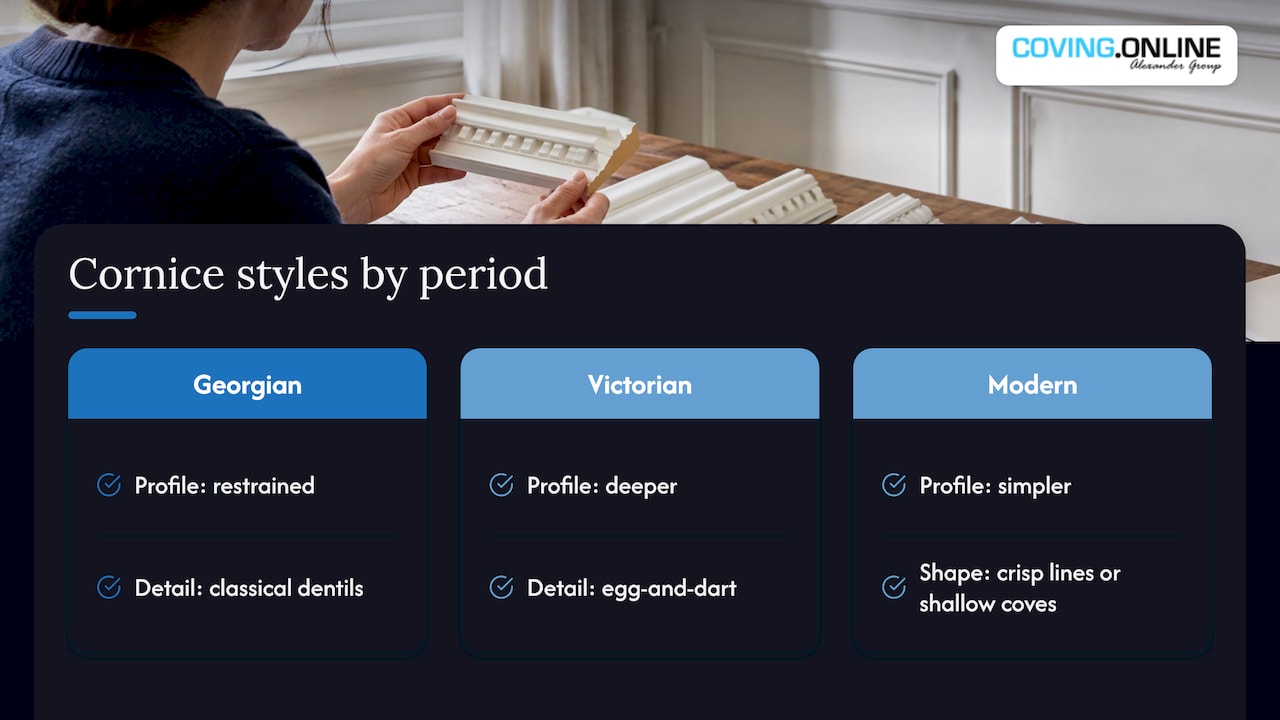
Style follows the age of the house. House & Garden describes Georgian cornices as restrained, with classical details such as dentils, Victorian rooms as favouring deeper profiles with egg-and-dart, and modern cornices as simpler, with crisp lines or shallow coves.
Is it dated? Designers quoted by Homes and Gardens call crown moulding far from outdated, adaptable from ornate to understated. Livingetc adds that in clean-lined new builds, narrower profiles and simpler shapes work best, while dentil and egg-and-dart remain timeless.
Our coving and cornice styles page helps you narrow the choice, and if you are working on an older property, see skirting boards for period homes.
Materials: why the word has changed
Traditionally, mouldings were solid milled wood or plaster. Polyurethane is now common because it is light, consistent and straightforward to cut and fix. Orac Decor and NOËL & MARQUET profiles are polyurethane and cover traditional and contemporary shapes, so you can specify an ornate Victorian look or a slim modern line from the same supplier. You will also see the main material types compared in our coving and cornice guide.
If you are also deciding on doors or windows as part of the same renovation, a supply-only uPVC windows and doors guide covers the architectural basics from the joinery side.
Carl’s Installer Tip
In our experience, the mistake we see most is ordering by the number on the box without checking projection and drop. A 125 mm coving can look heavy in a low room and thin in a tall one. We’ve found it helps to cut a short offcut, hold it in the corner and stand back before ordering the whole room. Mark the wall edge in pencil, cut internal and external corners on a mitre or coping basis consistently, and fix to a clean, dust-free surface with the right adhesive.
Our view
Moulding vocabulary looks like trade jargon, but each word answers a practical question: what is being covered, where does it sit, and how big is it? Once you know that, choosing becomes a matter of proportion rather than guesswork.
We think the best results come from treating the ceiling, walls and floor as one scheme. A cornice, a ceiling rose and a matching skirting profile from the same range look deliberate. That is why we supply the full Orac Decor and NOËL & MARQUET range and can also arrange installation through our Elite Decor UK national installer network.
Carl
Ready to choose
Once you know the term you need, browse our cornice and coving, skirting, ceiling roses and panelling ranges. If you would rather not fit it yourself, we can arrange professional installation across the UK through Coving.Online.

FAQ
Is coving the same as cornice?
Not strictly. Coving is a plain, concave profile, while cornice covers any moulding at the ceiling and wall junction, plain or ornate. In daily use the terms overlap, and many suppliers list them together.
Is it moulding or molding?
Both are correct. Moulding is the British spelling and molding the American one, so UK sites, including ours, use moulding.
How is coving measured?
Coving size is the diagonal across its face, not its height or projection. Check the projection and drop too, and measure each wall length for the quantity.
What is the difference between a ceiling rose and a medallion?
Both are decorative ornaments around a light fitting. Our guide to ceiling medallion vs ceiling rose explains how the terms are used.
Sources
- Moulding (decorative), Wikipedia
- Types of Decorative Mouldings Guide, DIY Doctor
- How to Put up Coving, DIY Doctor
- Unit 2.45 Manufacturing processes, BBC Bitesize
- Decorating Glossary, Dulux
- ABSP: Words, Architecture
- A short guide to the ceiling cornice, House & Garden
- Is crown molding out of style?, Homes and Gardens
- Is Crown Molding Out of Style?, Livingetc
Recommended
- Coving and Cornice Styles for Elegant British Homes Online
- What Is Cornice Moulding in Interior Design?
- Carl’s Installer Tip: Ceiling to Wall Transitions for DIYers and Pros
- Coving Orientation: 5 DIY Steps to Avoid Reversed Mitres
