
Home Decor
Measure, Fit, Budget: Installer Advice for Stairway Coving in UK Homes
Oct
The most reliable stairway coving choices are shallow modern profiles for low stairwells, deep period cornices for high-ceilinged Victorian and Edwardian staircases, and LED coving if you want drama and better perceived light on a landing. Material and installation choices decide whether the finish looks crisp for years or shows every mitre error. Specialist suppliers offer full Orac Decor and NOËL & MARQUET ranges with arranged fitting via installer networks.
TL;DR:
- Using polyurethane profiles from trusted suppliers like Orac Decor and NOËL & MARQUET ensures durability and ease of painting on stair coving.
- Shallow modern coving profiles are recommended for low stairwells to avoid visual constriction, while deep cornices suit high-ceilinged Victorian staircases for authentic period style.
- Accurate measurement of each stair, riser, and landing is crucial, especially for mitred joints involving winders or curved sections, to prevent costly rework.
- LED coving adds functional lighting and creates layered visual interest on landings, though it typically increases project costs compared to painted profiles.
- The total cost depends heavily on profile complexity, staircase size, and installation difficulty, with standard jobs generally starting around £350 for LED lighting and higher for detailed mitres.
Table of Contents
- Inspirational coving ideas for stairways
- Choosing materials and profiles for stairway coving
- Measuring and installation essentials for stair coving
- Costs, budgeting and value choices for stair coving projects
- Styling and finishing: paint, lighting and maintenance for stair coving
- Carl’s perspective: common stairway problems we fix and design choices we favour
- How Coving.Online can help with your stairway project
- Sources
- FAQ
Inspirational coving ideas for stairways
A stairwell behaves differently to a normal room. Sightlines run diagonally, ceiling heights shift between floors, and light falls unevenly across landings, so the coving style you choose needs to work from several angles at once, not just from one sofa view.
- Classic period coving and deep cornices suit Victorian and Edwardian stairwells with generous ceiling heights, and pair naturally with matching skirting and a ceiling rose on the landing for a coordinated period scheme.
- Shallow contemporary coving, typically in smaller profile sizes, keeps a low-ceilinged stairwell feeling taller rather than boxed in, and reads as a clean line rather than a heavy feature.
- Picture-rail and dado combinations frame a stair landing and give you a defined band for hanging artwork along the ascent, which works particularly well on long, straight flights.
- Tread cove and nosing trims finish the underside of a step neatly and can conceal joint lines and minor imperfections beneath a worn nosing, so they earn their place on refurbishment projects as much as new builds.
- LED coving accents set into the stringer line or landing ceiling add low-level lighting that improves visibility on the stairs while giving the space a more considered, layered feel after dark.
- Runner framing, where a stair runner is paired with coving along the skirting line, creates a sense of enclosure that suits narrower staircases and townhouse layouts.
If you want to test a palette or layout before committing, a design styling tool such as Blistr can help you visualise how a profile and paint colour will sit together before you order.
Choosing materials and profiles for stairway coving
Stairs put unusual demands on a moulding: uneven wall lines, curved strings, and mitres that rarely sit at a clean 45 degrees. Polyurethane profiles from Orac Decor and NOËL & MARQUET handle these conditions well because they are light, dimensionally stable and take paint without the cracking that plaster can suffer on a moving staircase wall.
- Polyurethane resists knocks and damp better than traditional plaster coving, which matters on a stairwell that gets more foot traffic and temperature change than most rooms.
- Flexible profiles are the better choice for curved strings, bowed walls or winders, where a rigid length would need excessive cutting to follow the curve.
- A simple scale check, the 5-8% rule, keeps profile height in proportion to ceiling height so the coving frames the space rather than overwhelming it.
- Tread cove profiles are a different product entirely from ceiling coving: they sit under the nosing to tidy the step edge, whereas ceiling coving runs along the wall-to-ceiling junction on landings and stairwell walls.
Measuring and installation essentials for stair coving
Stairs are where coving jobs go wrong most often, usually at the mitres. Getting the measurements and sequence right before you cut saves far more time than it costs.
- Measure each tread and riser individually rather than assuming a repeat, then multiply by the step count and measure the landing separately, since landing runs are rarely a clean multiple of the stair pitch.
- Add a waste allowance for patterned or moulded profiles, since offcuts from angled stair mitres are harder to reuse than straight-run waste.
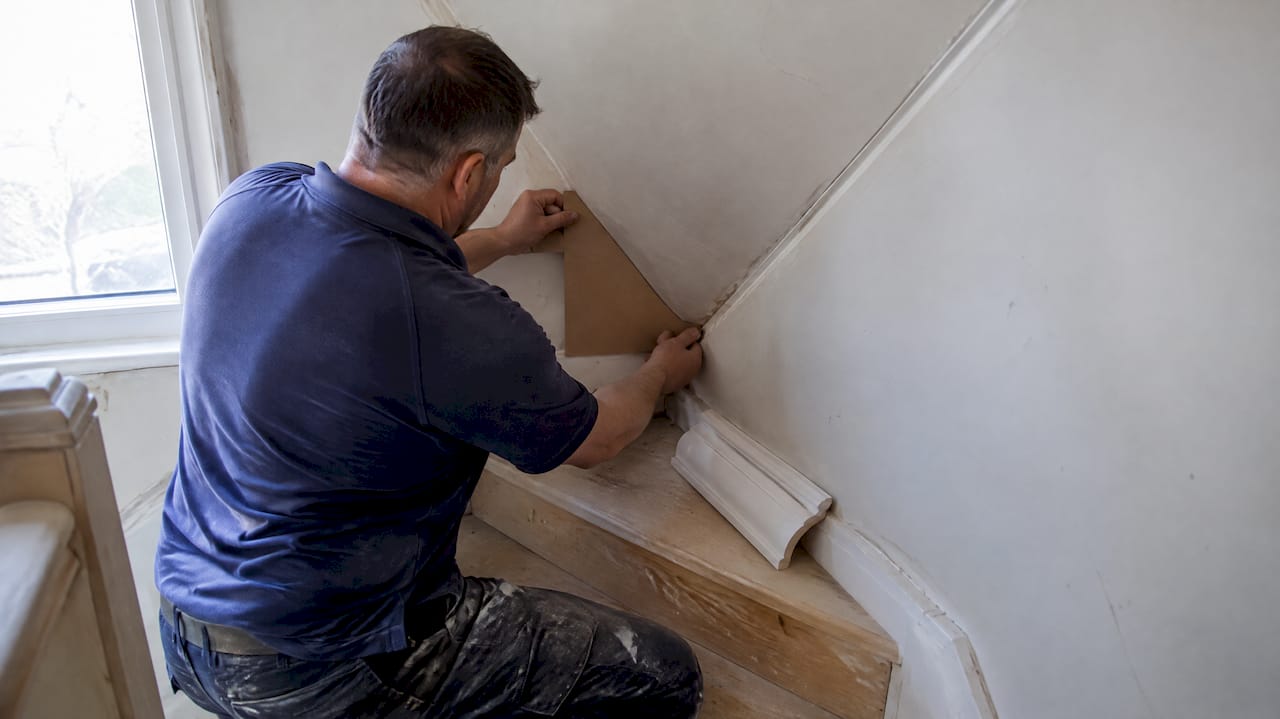
- Template winders and tight turns before cutting, or use a flexible coving on these sections, because standard rigid mitres rarely close cleanly on a winder.
- Check handrail clearance and headroom at every point the coving runs, keeping profile depth shallow enough that it never reduces safe passing width or head height.
- Use a proper mitre saw, a trade-grade adhesive, and back-butter each length before fixing, then caulk the joins for a seamless painted finish.
Our installer guidance on fitting over wallpaper covers awkward angles on stairway walls in more detail, including how to handle joins where paper meets a fresh mitre.
Carl’s Installer Tip: In our experience, the single biggest cause of rework on stairs is cutting a winder mitre from a measurement taken on the flat. We always dry-fit a template on the actual angle first, because a stair mitre that looks right on paper often doesn’t close on the wall.
Costs, budgeting and value choices for stair coving projects
Coving competes for budget with other stair finishes, and it is worth knowing where the money actually goes before you commission work. A fitted stair carpet for a standard straight staircase typically runs to £450 to £650 supplied and fitted, with wider ranges for winders and landings, and budget carpet materials start around £8 to £10 per square metre before underlay and fitting are added.
Underlay quality changes the long-term cost picture: skimping on underlay tends to compress carpet faster, which means the cheapest option on day one is often the more expensive one over several years, a comparison worth having before you decide between a runner and a coving-led finish.
- Custom profiles, flexible mouldings for curved strings and LED channels all add cost above a standard straight-run cornice.
- Complex mitres on winders take longer to fit than a straight flight, which affects labour cost more than material cost.
- Prioritising the correct adhesive and a well-chosen profile over the cheapest option pays off in fewer callbacks for cracked joints.
- Combining a coving job with other trim or repainting work in the same visit reduces the per-job call-out cost.
Measure your stairwell and photograph the awkward sections before requesting a quote, since accurate detail up front avoids a second site visit.
Styling and finishing: paint, lighting and maintenance for stair coving
A pre-primed polyurethane profile cuts down on-site preparation, which matters on a stairwell where scaffolding or ladders make repeat visits inconvenient. Our guide to the trade paint sequence covers the order and sheen choices that hold up best on trim that gets touched and knocked more than a standard wall.
- Use a durable eggshell or satin finish on stair coving rather than a flat matt, since high-touch trim shows marks faster in matt finishes.
- Choose a diffuser and routing path for LED coving that avoids glare at eye level as you climb or descend the stairs.
- Inspect joints and caulking every couple of years, since a stairwell’s temperature swings can open small gaps before they become visible cracks.
- Re-caulk promptly at the first sign of a visible join to stop dust and staining settling into the gap.
Our LED coving cost guide sets out indicative fitted job ranges for anyone weighing up lighting against a simpler painted profile.
Carl’s perspective: common stairway problems we fix and design choices we favour
Most stairwells we’re called to have some asymmetry the homeowner has stopped noticing: a landing that’s a few millimetres out of square, or nosings worn soft by decades of feet. Coving can hide these quirks or draw attention to them depending on the profile you pick, so we tend to favour a handful of Orac Decor profiles that flex well and mitre predictably, because repeatable results matter more on a staircase than anywhere else in the house. We reach for LED coving when a landing genuinely needs the extra light, and a simple painted profile everywhere else.
— Carl
How Coving.Online can help with your stairway project
Coving.Online supplies the full Orac Decor and NOËL & MARQUET range and can arrange fitting nationwide through the Elite Decor UK installer network, so you can source the profile and book the fitter in one place.

Before requesting a quote, have ready:
- Measurements for each flight, riser and landing, taken separately rather than assumed.
- Photographs of any winders, curves or awkward junctions.
- Your preferred profile or style, or a note that you’d like advice choosing one.
Get in touch through our installation page to arrange a quote, or browse the Cornice & Coving range to see profile sizes and pre-primed options before you order.
Sources
- Bookabuilderuk
- Carpet cost per m² UK 2026 | supply, underlay & fitting prices – yumiHome
- Red oak tread cove moulding product notes | WoodStairCo
FAQ
What is the cheapest way to cover stairs?
A painted shallow coving profile combined with existing treads is usually cheaper than a full carpet replacement, since a fitted stair carpet for a standard flight typically costs £450 to £650 supplied and fitted. Choosing a standard rigid profile over a custom or flexible one also keeps material and labour costs down.
What are the staircase trends for 2026?
Shallow contemporary coving profiles and low-level LED coving accents are popular choices for stairwells, particularly where ceiling height is limited. Runner-and-coving combinations that frame a stair visually are also a recurring request among homeowners refreshing period and townhouse staircases.
How do you decorate a corner stairway?
A picture-rail and dado combination works well on a corner or turning stairway, since it gives you a consistent band to carry artwork or colour around the turn. Coving along the ceiling line at the same height on both walls helps the corner read as one continuous space rather than two mismatched runs.
How can I make a stairwell look better without a full renovation?
Adding coving at the wall-to-ceiling junction, repainting trim in a durable eggshell finish, and fitting a tread cove to tidy worn nosings are all changes that improve a stairwell without structural work. LED coving on a landing can also lift the space by improving light without an electrician rewiring the whole run.
How much does it cost to install coving on stairs?
Coving.Online does not publish a fixed installation price, as costs depend on stair length, profile choice and mitre complexity, so accurate quotes come from measurements and photographs submitted through the installation page. LED coving jobs, by comparison, typically cost £350 to £700 for a fitted installation in the UK.
Recommended
